Is it possible that I chose to live in this country? Yes, yes, I think I did. No, this is not going to be one of those, “The funniest thing happened to me today on the bus ride through the city” blogs. This is going to be closer to “The crisis we are facing in our country today is one of great proportions, coming from so many directions that one can get dizzy trying to catch a glimpse of them all.”
I got home this evening, after a two-day educational tour around the southern part of the country, to find out there was a terror attack in Eilat yesterday. Before I glanced down at the colorful “Yediot Ahronot” (“Latest News”) newspaper carelessly thrown on the dining room table and the horrible news gracing the front page, my roommate asked me, “How was it?” “Well, I can’t say it was enjoyable,” I said, in my first attempts to shed off the emotional, physical, and daily hardships of the people I met on my trip, “But it was an experience I needed to have.”
Only after I had dinner and relaxed a little did I notice the paper and the headline, “Terror in the Vacation Town.” What I cannot get over is why I hadn’t heard about it. Earlier today, the director of our program said that the experiences we have had over the last couple of days were “punches in the gut” and should wake us up. The three punches:
1) Meeting settlers taken out of the Gaza Strip during the Disengagement
2) Meeting a Sderot resident and learning why the kassam rockets that fall on their town is sometimes the least of their worries
3) Meeting a Bedouin man whose village, despite all the evidence in the world, is not “recognized” by the state of Israel.
While the groups represented are very, very different is many, many ways, a common thread wove them all together—I don’t believe in the state anymore; I can’t make a difference; nobody, nobody cares about our lives.
And then, the fourth punch in the gut arrived—the terror attack which killed three people, that, like I said, I can’t believe I didn’t hear about.
The rain that started to pour down as we left the south, the flood that greeted our return to the Holy City, is close, very close to my mood right now.
So, what do you when you’re punched in the gut? Well, you hunch over for a bit, try to regain your breath, and then with your first full intake of air, thank G-d you’re ok. So, that’s what I’ll do for now. In the coming days, I’ll write more about the specific experiences above because the things I heard were said in vain if nobody else knows about them.
Tuesday, January 30, 2007


Wednesday, January 17, 2007
Words of "Wisdom" from the 1950s
It is too seldom remembered in the American society that working girls and career women, and women who insistently serve the community in volunteer capacities, and women with extracurricular interests of an absorbing kind are often borrowing their time and attention and capacity for relaxed play and love from their children to whom it rightfully belongs. As Kardiner points out, the rise in juvenile delinquency (and, he says, homosexuality) is partly to be attributed to the feminist movement and what it did to the American mother. --Robert Lane, American political scientist, 1959
Thursday, January 04, 2007
Snow, Strikes, and Other Great Reasons Not to Go to School
And then, I remember, I live in country with a socialist tendency. There was no school yesterday--all the students of major universities (and some smaller colleges) --numbering 125,000 in total--decided to strike in order to show their protest to the plan to increase the tuition next year to something unpayable by most Israelis seeking higher education.

The week before, on Wednesday, we had snow and classes were canceled in the afternoon. This week, students formed a picket line at the major university entrance gates and wrapped the doors/gates in chains to prevent potential "scabs" from entering the university. (Note: No teachers were harmed in the shooting of this film) The exception would be the international students--those who attend a special school at the university that provides classes in English--who are already paying ridiculous amounts of American dollars to attend classes.
There are several reason why this fight does not necessarily affect me but why I support the cause:
1) I don't have classes on Wednesdays, so I did not face the moral dilemma of whether or not to strike. But I have to say, if I did, theoretically, have class on Wednesdays, I would also not go. Students Unite!
2) Because I am a new olah (a new immigrant, of the right age, by the way), the government is paying my tuition, so I guess if they decide to raise the tuition, they will have to pay a higher cost for me. However, I know that morally it is my fight to fight--after all, this could the tuition I have to pay for my own kids one day. Also, if they raise tuition to such a high level, the government may take away this benefit from new young immigrants looking to study in Israel.
There are many details of the whole tuition-raising process that are causing suspicion and anger among students and faculty, but in short, here are a few:
1) A committee was appointed by the Ministry of the Treasury--government officials and senior professors. Noticeably missing were any students. AFTER the demonstration--a call from the committee chairman for students to join the committee.
2) Past promises--from another committee--to decrease the tuition have yet to be enacted. And now, they are talking of substantial tuition raises.
You may think that professors would be upset with the whole deal. But from what I've heard--keep in mind I study in the liberal (not only in name) arts--teachers are supportive. That teachers showed up to teach yesterday is part of the strategy organized by the student union and the academic faculty's union--they may need a new card in the future (i.e. the teachers also striking). However, I heard several teachers say, "Of course you all shouldn't show up."
And so, what could I do but not show up? The "other reason not to go to school," strolling the pedestrian mall in town popping into bookstores on a beautiful sunny day.
Wednesday, December 27, 2006
Studying in a Winter Wonderland
So, I guess my professor is not having office hours. He warned us: "If it snows on Wednesday, I will not be in my office." Let's hope he's at home sipping hot chocolate and sitting next to the fireplace.
I admit it--I lied. I said, "I don't want snow; it will only make my little bedroom--fondly referred to as the 'Mini-Frigidaire'--even colder". But as I sit inside now, surrounded by "Patterns of Democracy: Government Forms and Performance in 36 Countries" and "Theory and Methods in Political Science," I can't help but gaze out the window. Now that I look out my picture window to the snowy neighborhood of Katamon, I take back my words and think to myself that is really is beautiful.
And I realize that in a world that often concentrates on the ugly, bad side of things, we have to take advantage of every chance there is to see the beauty.
Unfortunately, this snow has been accompanied by a lot of rain, strong winds, flooding, people's houses falling down and a high number of road accidents (Article). However, there are some good things going on. For instance (from the Jerusalem Post): In light of the expected freeze, the Jerusalem Municipality rented hotel rooms for the city's homeless to at least give them a roof over their heads.
Let's just wish everyone else a safe (if wintery) week.
A few pictures for your enjoyment:

Don't be scared . . . he's only 8 inches tall!

 And by the way, since I don't have a fireplace, can someone sit by one for me?
Wednesday, December 20, 2006

Sunday, December 17, 2006
I Made an Illegal Turn . . . and Obviously My Country Did, Too
I turned left yesterday when I wasn't supposed to. No, this is not a joke about Derek Zoolander and his inability to turn left--this is real life (or at least the semi-real life adventures that make it to my blog not entirely rewritten for attempted comic relief). Yes, I broke the law. The feds chased after me through the quiet streets of Rechavia after breaking the simplest of traffic laws. (Well, if by chased you mean sitting at home watching reruns of Eretz Nehederet , the Israeli "Saturday--errr, Friday, Night Live," then yes.) No, there were no cops, but there was the realization that Jerusalem--at least in the aspect of prohibited left turns whenever you need them--is turning into Tel Aviv, AKA "The city that never sleeps (because everyone is still driving around trying to turn left)."
So, in a car rented by a friend who needed my help moving but who still hasn't gotten her Israeli driving license, I embarked on my first Israeli driving experience after my driving test (make that one plural) over a year ago. My trusty Israeli side-kick, after seeing that it was very clearly marked that the turn I needed was illegal . . . encouraged me to do so anyway. So, I turned.
And it seems our country as a whole did, too, this last year.
I woke up this morning to read the headline, "Rich, poor gap deepens despite major economic growth." Honestly, this is the type of headline that could appear in almost any country's newspapers, so it didn't initially shock me. That is, until I read the article (http://www.haaretz.com/hasen/spages/802011.html).
Two chilling facts from the report published by the Adva Center:
*The highest paid individuals in Israel earn 50 times more than those earning minimum wage.
*55 percent of 17-year-olds failed to earn high-school diplomas in 2005.
Ok, so we are living in an increasingly capitalist society that targets the salaries to the sectors that bring in the money. This is understandable. But this country was built on socialist roots--we are supposed to actually care about inequality, about the fact that poverty in Israel has changed from an anomaly to a set trend for a large percentage of people.
The report emphasizes that growth is a good thing, but it must be managed by and alongside a public policy that takes into account other sectors of society--one that can "spread the wealth."
I know the argument against this--But if they are earning the money, why must they give it up? The answer is simple: Because construction workers, merchants, street sweepers, bus drivers, teachers (!), gardeners, at-home parents, nurses, and more make up and support the society that allows certain individuals to earn 421,000 shekels a month while others earn a meager 3,000 a month.
I'm not an economist, but I I don't think it takes a mathematical genius to see the major negative aspects of this situation:
1) Such a large socio-economic gap is currently not good for Israeli society as a whole--when at least 600,000 children go to bed hungry every night, when 25% of the population is living below the poverty line and their precarious positions are only sinking each year.
2) Such a large socio-economic gap will not be good for Israeli society in the future.
One must only read the second fact above--the rate of young adults not acquiring even the most basic of educational goals--to be assured of this.
So, why have we turned the wrong way, when to some of us, the right way seems like such a clear choice? I am not sure of the answer to this question, but in the meantime, we can't afford to make any more wrong turns.
Sunday, November 26, 2006
The First Thanksgiving (Minus the Pilgrims and the Native Americans and the turkey and . . . )
The numbers were not looking good. It was Friday at 11am and this year's Thanksgiving was in danger of being taken over by foreigners. No, I'm not talking about Pilgrims who were anxious to infect Native Americans with new germs. I'm talking about something slightly more serious here--non-Americans who have never sat and watched 14 straight hours of parade coverage-football marathons while stuffing their faces with turducken (a very sick prospect if you ask me, but click on the link anyhow http://en.wikipedia.org/wiki/Turducken), pumpkin pie, sweet potatoes, and whatever else doesn't run away from them.
That's right--7 people were coming to dinner and the number of Americans was 2. 2/7 is not good odds if you are trying to have a real Thanksgiving dinner in a middle eastern country where finding cranberry sauce is only slightly easier than establishing a peace treaty. And then my friend Zach called. "I just wanted to wish you a happy Thanksgiving since I know it's your favorite holiday of all time."
He's right, and I was doing my best to bring Thanksgiving to my humble little apartment in Jerusalem and the natives of the land. Since we wouldn't be having a real turkey this year (or a turducken, for that matter), I had invested in a bit of multi-colored construction paper and made place cards for everyone in the shape of turkeys (or my hand, you know the deal--trace your hand, now cut it out and make the thumb the turkey head and so on . . . ). So, Zach was invited (a real "Mer-ken"), and the gap decreased by one.
The number of countries represented at Thanksgiving dinner on Friday was slightly lower than the number on the UN Security Council: United States (Florida, Michigan, and North Carolina), Israel, Norway, United Kingdom, The Netherlands, and Canada.
The cranberry sauce was found and brought by the Dutch ambassador, but unfortunately, the British emissary screwed it up. To be fair, she apologized after the American contingency explained to her that it is absolutely essential that the cranberry sauce maintain its molded can-shape, with the rings visible to the naked eye, and that mashing it for aesthetic appeal wasn't acceptable. The Norwegian (and her American liaison) brought banana nut bread and chocolate cake and a variety of Thanksgiving (and Southern) delights were provided by myself and my Israeli consul general.
Overall, it was a great night. But if you were paying attention, you may have noticed there's a problem with my story. Yep, that's right--we did it on Friday. But you know, maybe the Pilgrims did, too. I mean, when you're cooking a turducken on a spit, it takes a little bit longer . . .
Thursday, November 23, 2006
Driving Without a License
As I headed towards Mahane Yehuda (one of Jerusalem's famous open air fruit/vegetable/meat markets) this morning, I decided that today was the day to buy an agala. I won't give you the literal translation of the word because the one my roommate provided finds favor in my eyes.
"You bought a little-old-lady-cart?" she said, when I informed her of my purchase.
"I bought a cart."
"Where is it?" she asked.
"In the corner over there."
"It's plaid!"

Indeed, it is plaid. My plaid little-old-lady-cart.
But if you ask me, it's a necessity--not of being an old lady, but of being a true shopper of the shuk (market).
First, having a cart allows you to intimidate other shoppers. In the crowded alleyways of the shuk, this is essential. Not only do vegetables rolling off huge piles threaten to dampen your progress as your make your way towards your favorite tomato guy (you know the one, he sings about it being the tomato's birthday and that's why it's on sale), but little old ladies (note: ALL with their plaid carts) often attempt to trample you on their way to the cheapest whole-shiny-smoked fish (if you are imagining it being gross, you are correct).
Second, pulling your cart around relieves stress. I speak now not only of the back pain and finger pain (hold 27 plastic bags full of peppers and olives in your hands and you'll understand what I mean) which inevitably accompanies a shuk visit, but also of the stress my boyfriend likes to express in the following sentence, "Don't send me there--no, not on a Friday--no, anywhere but there." My exercise for relieving this stress is as follows:
1) Pull your cart without watching where you are going (this is a skill one learns very quickly once moving to Israel).
2) Run over as many people's toes as possible.
3) When you feel a bump (someone's left pinky-toe being taken off in one fell swoop), turn around with a shocked look on your face and say, "I'm so sorry, I didn't mean to."
4) Turn back around and smile devilishly.
5) Repeat steps 1-4 in every alleyway of the shuk.
6) Join the witness protection program because the little old ladies with their carts will probably recognize you next week and come after you brandishing cheap-whole-shiny-smoked fish.
The third, and certainly not final, benefit of having a little-old-lady-cart is that it allows me to use my driving skills for something. Since I received my driver's license (a disheartening story which can be told at another time or . . . NEVER), I have not driven in Israel. Wait, I once moved someone's car to another parking space--it was thrilling. If you don't use it, you lose it. And just to prove how close driving a car is to driving an agala, the man who sold me the little-old-lady-cart (despite my being under the legal age limit) asked if I had a license to drive it.
As I headed out the store, with my new cart in tow, he called after me, "Have a good trip!" And I did--except you know, I have to say, prices just aren't what they used to be when I was a kid.
Tuesday, November 21, 2006
93 Seconds . . . Longer than a Lifetime
I did it. I finally did it. Yep, I spoke in class. And not just to say, "Here," when my name was called on the roll. No, I said . . . something, something intelligent even.
"What's the big deal?" you ask. "You, of all people, are not afraid to talk." In fact, it could even be said, that I'm . . . talkative. Well, what happened to me was aliyah. Moving to a new country can significantly affect how you talk, when you talk, and with whom you feel comfortable sharing your old wisdom in your new language.
The first time I noticed my lack of willingness to participate in conversation was when I was in a group of Israelis who assumed my Hebrew was good enough for them to continue speaking in Hebrew instead of translating everything for me or conducting the conversation in English for me. I, like many olim (immigrants), assumed that I knew what was happening in the conversation. I've heard so many times over the years--in fact, said it myself: "Oh, I understand everything that people say to me; it's just hard for me to form sentences of my own." Let me clear things up. You, I, think we understand everything that is being said, but the more Hebrew you learn, the clearer and simultaneously more confusing things become. Because the more you learn, the more you realize you don't know. The words that before were lost in a sea of quickly spoken Hebrew words now stick out--and you realize you have no clue what they mean and how much of the conversation you are really missing.
This is what university in Israel for olim is all about. Realizing that, "Wow, there are a lot of things I still don't know." That and, to be fair, how much you do know compared to the people around you. A few weeks ago, I sat in a political philosophy class listening to Israeli students speak about "American culture," a central topic in the reading for the week. I must say, Israelis, in many ways, are able to capture the essence of American culture in a way I never thought they were capable of doing. They are outsiders looking in and this gives them a certain objectivity. However, there was something missing--"Oh, right, they've never seen 'Saved by the Bell' or gone trick-or-treating and they make fun of peanut-butter-and-jelly sandwiches." That's why they don't truly understand. It hit me. Who am I? I'm American sometimes. I'm Israeli sometimes. Oh, yeah, I'm an immigrant.
About speaking in class, though, some of you would argue, "But your Hebrew is great (i.e. your American accent barely comes out when you speak--It's always there, waiting to pounce at the most embarrassing opportunity!)" I'll say it once: It doesn't matter. Speaking to a taxi driver, speaking to a friend, speaking to a doctor--these are not the same as speaking in front of 50 people in a class. However, this week, my opportunity (read: moment of greatest fear) finally arrived--I had to present Plato's "Cave Allegory" since my slacker group members had not read it.
I boldly (read: with a shaking voice and looking at my notes--written in Hebrew--every few seconds) explained the allegory. And after one repetition in the middle--where I got a little nervous after not knowing how to say what I wanted--and a faked smile, I finished. I survived. 93 seconds of pure hell.
But the teacher said, "Very good description." So, I figure, maybe . . . sometime during the next two years of my master's degree, I'll do it again.
Oh, right, I have to give a ten-minute presentation next week.
Friday, November 17, 2006
I'm an aunt (and a hunted species)
I'm an aunt, I'm an aunt, I'm an aunt (come on, sing with me, to the tune of "Yellow Submarine", right, if you didn't try, then you don't know that it doesn't go with that tune--I was actually humming "Stars and Stripes").
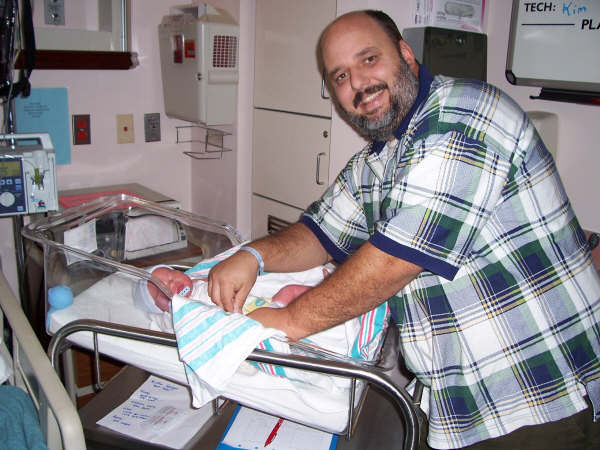
Yes, little seven-pound nineteen-inch cute as a button Stephen Michael was born yesterday morning. My brother's sister (Those of you who are paying attention will notice that this person is me. In fact, it is my brother's wife who gave birth on Tuesday. For some reason, I kept saying it wrong to everyone I told.) gave birth at 8:09 am in Pensacola, Florida. According to all sources present, he has 20 toes and fingers (inclusively) and is:
1) very cute*
2) very small
and 3) reminiscent of his father (except he has more hair!)
*See pictures above for proof of his cuteness.
Now is the time I feel it--that is, exactly how far away I am. I sit here in the university library behind a pile of books in a language not exactly my own and wonder if Little Stephen would find the book "Reexamining Democracy: Essays in Honor of Seymour Martin Lipset" interesting at all. I wonder if I'll get to spend time with him and if he'll know who I am. Will he study political science like me? Or will he choose a more "profitable" educational field like zoo-keeping or astronaut-ing? I wonder if his first word will be "Mama." Perhaps it will be "Democrat."
So many questions and so much time for him to explore the world. It's inspiring, I think--Little Stephen's new venture into the oxygen-breathing sector of the universe.



(And now a bit of irony)
On another note, in our weekly telephone conversation, my mother reminded me that every time one of her co-workers finds out where I live, he/she gasps and says, "Are you scared? Isn't she scared?" The answer is usually "No." But as I walked through one of Jerusalem's nicer neighborhoods last night on my way to meet friends for a drink, I encountered a chilling reminder of how much hate exists in the world. The graffiti I saw scrawled on the stone wall surrounding a beautiful house reminded me of the graffiti so common on random walls in Jerusalem--"wise" pronouncements of "Death to Arabs", "Death to Gays (or insert "Animals", which is a fond nickname of some sectors of society for non-heterosexuals), "Death to Rabbits" (a play on words and the slogan "Death to Arabs" in Hebrew)--graffiti that more often than not stays up longer than the current parliament coalition. Except this time, I was the target. No, it didn't say, "Death to Kind, American-ish, Liberal-ish, Idealist, Humorous, Likes Spaghetti Girls in their 20s". What was written was far more explicit (and you ask yourself, "Gee, how can it be more explicit than that?")--"Death to Vegetarians."
So, as I walked home last night, I looked over my shoulder . . .
Not for rabbit/gay person/Arab hunters, but for the guy who could see my low-iron content and knew . . .
Yes, little seven-pound nineteen-inch cute as a button Stephen Michael was born yesterday morning. My brother's sister (Those of you who are paying attention will notice that this person is me. In fact, it is my brother's wife who gave birth on Tuesday. For some reason, I kept saying it wrong to everyone I told.) gave birth at 8:09 am in Pensacola, Florida. According to all sources present, he has 20 toes and fingers (inclusively) and is:
1) very cute*
2) very small
and 3) reminiscent of his father (except he has more hair!)
*See pictures above for proof of his cuteness.
Now is the time I feel it--that is, exactly how far away I am. I sit here in the university library behind a pile of books in a language not exactly my own and wonder if Little Stephen would find the book "Reexamining Democracy: Essays in Honor of Seymour Martin Lipset" interesting at all. I wonder if I'll get to spend time with him and if he'll know who I am. Will he study political science like me? Or will he choose a more "profitable" educational field like zoo-keeping or astronaut-ing? I wonder if his first word will be "Mama." Perhaps it will be "Democrat."
So many questions and so much time for him to explore the world. It's inspiring, I think--Little Stephen's new venture into the oxygen-breathing sector of the universe.



(And now a bit of irony)
On another note, in our weekly telephone conversation, my mother reminded me that every time one of her co-workers finds out where I live, he/she gasps and says, "Are you scared? Isn't she scared?" The answer is usually "No." But as I walked through one of Jerusalem's nicer neighborhoods last night on my way to meet friends for a drink, I encountered a chilling reminder of how much hate exists in the world. The graffiti I saw scrawled on the stone wall surrounding a beautiful house reminded me of the graffiti so common on random walls in Jerusalem--"wise" pronouncements of "Death to Arabs", "Death to Gays (or insert "Animals", which is a fond nickname of some sectors of society for non-heterosexuals), "Death to Rabbits" (a play on words and the slogan "Death to Arabs" in Hebrew)--graffiti that more often than not stays up longer than the current parliament coalition. Except this time, I was the target. No, it didn't say, "Death to Kind, American-ish, Liberal-ish, Idealist, Humorous, Likes Spaghetti Girls in their 20s". What was written was far more explicit (and you ask yourself, "Gee, how can it be more explicit than that?")--"Death to Vegetarians."
So, as I walked home last night, I looked over my shoulder . . .
Not for rabbit/gay person/Arab hunters, but for the guy who could see my low-iron content and knew . . .
Wednesday, November 08, 2006
Hate, abuse, and suffering--Served up hot and fresh
"For if you think that by killing men you can avoid the accuser censuring your lives, you are mistaken; that is not the way of escape which is either possible or honorable; the easiest and noblest way is not crushing others, but to be improving yourselves" --Plato, "Apology" (Socrates' Defense)
This week has been a bloody, fiery week. It's been a week of buses being re-routed, parades being re-routed, and lives of human beings--yes, human beings--being re-routed. So you won't have to guess what the above statements hint at, I'll tell you.
Yesterday, my bus was re-routed, from its usual course through one of Jerusalem's ultra-Orthodox neighborhoods, on the way home from the university due to the violent and non-violent protests of ultra-Orthodox Jews (in their own neighborhoods, thankfully) against the gay pride parade set to take place this Friday. Last year's parade was marred by the stabbings of three marchers. This year, it is not uncommon to see posters in certain neighborhoods advertising a reward of 20,000 shekels for anyone who kills a marcher. I wonder, "Is it possible that I live in a city like this?" I wonder, "Did the people in Selma, Alabama have this thought, too?"
The parade--or the "parade," since as I write this, the Israeli Supreme Court is in session to determine whether a "safe" parade can indeed take place in our city--was given a new route yesterday. The original route by-passed the aforementioned neighborhoods. The second route by-passes them even more.
Oh, but don't worry. The number of people within Israel who hate each other has not yet exceeded the number who hate each other across the formal and informal borders of the country. The numbers of those killed in Gaza by a misfired Israeli artillery shell this morning continue to go up as well (http://www.haaretz.com/hasen/spages/785380.html). As do the number of Palestinian women who are sexually, physically, and emotionally abused according to a recent report by the Human Rights Watch (http://jurist.law.pitt.edu/paperchase/2006/11/palestinian-authority-ignores-violence.php).
I think about the US mid-term elections, whose results have just about come in by now. I think about the issues on the ballot and in the news. And I think to myself, "If only we could think about 'stem-cell research' here. If only the minimum wage was the biggest thing on our minds here." But I realize that America's continued presence in Iraq (and Afghanistan, has everyone forgotten Afghanistan) is life-and-death just like the things facing us here. But it's on the other side of the world compared to America--oh, right, it's in our neighborhood--it seems less real.
I was always told--and sometimes I still believe it--that the world is not any more violent now than it was throughout world history. "We just have news now--up-to-date, live feed, instantaneous broadcast news--that brings hunger, poverty, massacres, and terrorism to our doorsteps faster than the pizza delivery man can bring us a sardine-and-onion thin-crust pie." But proximity to the violence makes me think otherwise.
So, what do we do? No, no really, what do we do--to improve the chance (if not the reality) of peace, to guarantee (if not living to an old age) at the least the chance to graduate from high school, to value life in such a way that forces us to change our trajectory course that we claim was set so long ago but that in reality we choose anew every day?
Thursday, November 02, 2006
Do I believe in peace?
I recently received an email from an acquaintance who told me: "I've been talking with a lot of people who are ready for eternal peace." It was nice to hear it, because around here, it's a bit harder to find those people.
The first person who comes to mind is the man who murdered Israeli Prime Minister Yitzhak Rabin eleven years ago today. He wasn't thinking about peace, eternal or not.
I think next of Hamas, who has upped its ransom demands to 1,200 Palestinian prisoners in Israeli hands in exchange for the Israeli soldier they kidnapped over 3 months ago.
I think now of the Moroccan man who is $12,000 richer after winning a Holocaust cartoon contest sponsored by the government of Iran.
These people they don't believe in peace. They don't even hope for it.
Now I think of myself. I hope for a perfect, eternal peace, but do I believe in it or at least the possibility of it?
No. I don't.
I am an optimist. I believe in the goodness of humanity. I am in personal ways working towards the goal of coexistence. I think we can arrive to a situation better than the one we are in right now. But I don't believe in a complete peace.
Why? Because of the people above.
Why? Because I've been here a little too long to continue closing my eyes to the reality in front of my face.
Why? Because for every prayer of peace that rises towards the sky, a bullet flies into an innocent human being.
So, why am I here-that is, if I think the situation is hopeless? The answer to that question lies in the meaning of today--the 11th anniversary of the assassination of Yitzhak Rabin.
This story does not start eleven years ago, but rather three. I was in Arad, Israel and was taking part in a group discussion, "Where were you when you heard about Rabin's assassination?" Like asking an American where he was when he heard of Kennedy's assassination, everyone had a story--everyone but me. I couldn't remember. I was thirteen years old, and yet, I didn't know. I imagine to myself now that I first heard of it in Sunday school, as it happened Saturday night Israel time, and that would have been the first opportunity for me to hear of it. But I don't know, because at that point, Israel--a place that is so important to me today--was not even on my radar screen. That night, though, three years ago, something inside of me clicked, and I knew--knew--that this would be the last time that something happened in Israel of such great import that I didn't know about. That was the day that I decided to make aliyah, to make Israel my home.
Knowing myself, knowing my dedication to positive interactions of human beings in the world, knowing the steps Rabin took to achieve peace in Israel--it seems fateful that this should be the day my decision was made.
And so, I sat this morning on my balcony, looking out into the cloudy morning, wondering where we are headed? I looked down to the nursery school playground next to my apartment building and listened to the children shrieking and laughing and . . . living. They had no idea what day it was, and thought to myself, "Wouldn't it be great if they never had to learn of the hate that causes something like this day? Wouldn't it be wonderful if by the time they grow up this chapter of violent history is over?" Yes, it would. But something tells me it won't be.
And it's not ok. But . . . there is still beauty in the world. There is still happiness and love. There is still, well, a little spark of hope that makes me think, "It won't be perfect, but it will get better . . . someday."
Sunday, October 22, 2006
Gnome Snatching and . . . (well, basically just gnome snatching)
Captain's log, Star Date October 2006 (Becky and Nadav's trip Way Down South)
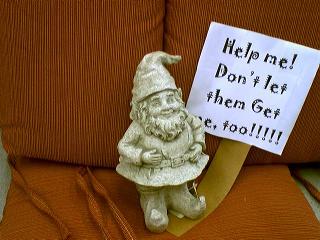
It's been said once or twice (but certainly no more than that, sarcasm, sarcasm, sarcasm) that there isn't much to do in Pensacola, Florida besides go to the beach and see the Blue Angels. The following criminal action is proof of this. Upon reaching my friend Derek's house and seeing he had the nerve not to be there to visit me . . . I snatched his gnome. No, this is not an euphemism for . . . (well, you know). I took his garden gnome. What follows is a true, sometimes scary (well, not really) story of what happens when a mind from the underworld of dis-organized crime arrives to a small town like Pensacola.
STEP #1 After the gnome was thrown into the back of Derek's dad's kidnapper van (just kidding, I used my step-dad's truck), I drove off cackling into sunset and to my grandmother's house (do not worry, no grandmothers were harmed during the filming of this movie and she will not be brought up on accomplice charges).
The following ransom note was sent to Derek's personal email from gnome.snatcher@yahoo.com, an email address created by me and my partner and crime, to carry out the felony (well, in Vermont, gnome snatching is a felony).
"Dear Mr.Stephens,
Your gnome, AKA "Target Dwarf Extraordinaire", was kidnapped recently by the Dwarf Liberation Army. We dwarfs have a major problem with garden gnomes acting like they are better than us. If you want to see your gnome alive, you must rendevous with our group one evening this week. We have attached pictures that prove your gnome is still alive and in good health. If you want him to stay that way, wear a cowboy hat to our meeting with you. You will receive further instructions soon.
(DON'T TRY TO FIGURE OUT WHO WE ARE, WE ARE WATCHING YOU . . . AND WE KNOW WHERE YOU LIVE!)
Signed, The DLA - See above for explantion of acronym"
STEP #2 "Proof of the villainy"
We sent the pictures (below) to prove to him we meant business.
STEP #3 "Throwing the victim off the scent of the trail"
I called Derek to make sure he checked his email. Immediately, he asked if I stole his gnome. I have an innocent face, which helped me in this conversation, and convinced beyond the shadow of a doubt, that IIIIIII had no idea what the "DLA" is.
STEP #4 "Derek notifies the police (ok, just his friends)"
Derek forwards the DLA's email to his friends and responds to the DLA's email:
"Wow! I'm intrigued, entertained and disturbed all at the same time!
(you can also throw completely puzzled onto that list) Thankfully I
do have a cowboy hat... though I'm leaving for panama city tomorrow
until Thursday afternoon for work... so please keep that in mind. I
can honestly say this is possibly the best e-mail I've ever gotten...
I suppose I'll await further instructions.
TDE-less Derek ...my little slice of the ghetto front yard just isn't
the same without him... please keep him safe! haha... whoever this is."
Signed, Derek
STEP #5 "Turns out Derek has more than one weird, sadistic friend"
Derek's friends, liking the fact that someone would be so weird to steal Derek's special Target employee garden gnome and taunt him (Derek, not the gnome), run with the idea.
Voice messages with smurf-like voices, claiming to the the DLA, flood his voice mail. He even receives another picture from a "copy-cat DLA" group (below).
STEP #6 "The culprit is revealed"
One week after the crime, Nadav and I, cowboy hat in hand and displayed clearly, arrive to breakfast at the Waffle House with Derek and find out the details of his gnome-less week. A moment before he leaves, I tell him that I have a present for him, Mr. Target-Gnome-Extraordinaire!

The evidence . . .
The first 4 pictures are those the gnome snatchers took and sent with the ransom note. The last picture was sent by an unidentified copy cat gnome snatcher.


Wednesday, September 06, 2006
Are we there yet?
"Map of Jerusalem" the sign on the sidewalk says. I pass by it while I am on the bus on my way home from the university. Suddenly a memory from 3 years ago rises from the ashes of my jumbled brain—the brain that now thinks in 2.5 languages (English, Hebrew, and a squeak of Arabic) and prohibits me from speaking any of them well. It was a Saturday night when my friends and I tried to make our way from the German Colony neighborhood to the center of the city. It was late, it was dark, but we had a native Jerusalemite with us, and we figured that improved our chances of success. We did succeed in arriving (finally), but during our adventure roaming different neighborhoods of the city, I remember coming upon a map such as the one described above and thinking that Jerusalem is a maze of streets, a labyrinth that I will probably never understand. And now, strangely enough, I do. To be honest, the streets—many of which are not labeled well—are probably the easiest part of the city to understand.
The sign I saw today hints at the complexity and yet also at the humor hidden in the stones of this holy city. "Map of Jerusalem" the sign on the sidewalk says. "But where is the map?" I ask. The side I see is blank. "Maybe it's on the opposite side." I turn in my seat in order to check the other side, and the sign answers my question with a smile and a shot glass. Instead of a map, there is an advertisement for Johnnie Walker Black Label Scotch Whiskey. "Well," I think to myself, "At least it's not Manischewitz."
So, where are we going . . . really? We have certainly not arrived to the place we want to be—the place perhaps, but definitely not the situation. Not everyone would agree, but I think one needs to know who and where he is before he can determine where he is headed. Is it possible that this is exactly the situation in which we find ourselves now, or for the last (insert your number here) ____ years? I think quickly about all the maps and plans that have been drawn, revised, burned, re-drawn, announced, voted upon, denied, agreed upon, shaken hands about, protested over, laughed about, and cried over concerning this piece of land and the fate of its peoples, and I wonder if it would have just been better to sit down with our neighbors and have a shot of Johnnie Walker. I know someone who thinks so—someone who was in war, who has seen wars, and who has had enough of wars at his tender age of 61. I've had enough at the wise age of 24. Maybe that is what it will take, enough 24-year-olds—not 60-year-olds—saying, "We've had enough." We have a problem saying it over whiskey, but perhaps with war, we know our limits.
Tuesday, August 29, 2006


Sunday, August 06, 2006
Sing me a death song . . .
I've often discussed with friends how I feel that I have a soundtrack for my life. It's composed of many different albums, artists, and genres--ranging from Frank Sinatra to Weezer to "Baby got back". I think most of us have memories that are connected to music, even those of you who cannot carry a tune and are forced to express your musical genius to the shower head and shampoo. We hear a song and it takes us back to a time, a place, a person.
Tim McGraw's "I like it, I love it", a country hit from the 1990s, makes me think of my best friend since middle school, Suzy, and the times we would sing it loud and clear on Friday nights in her bedroom. "Ride wit me" (yes, the Nelly CD found its home in my dorm room freshman year thanks to my roommate, Jada) reminds me of my first taste of true freedom--my first weekend at college--when Jada and I rode around town with the song blasting from the car and cat-calling guys for fun (as it turns out, we went to bed relatively early that night, despite all our plans to be wild).
And any, any, upbeat seventies song reminds me of my mother dancing around the living room, reliving her glory days.
What songs will I think of when I remember back to my first war? Well, I am listening to the radio now and Faith Hill, an American country singer just came on. A few minutes ago John Lennon's "Imagine" was playing--and as beautiful and contemplative as it sounds, I just don't think it's realistic. But I guess that is what is so special about music--like all art, it takes us away from reality for a bit, it helps us try to deal with the events in our lives. Music softens the blow of the sad, gruesome happenings of the world, and yet, it also has the ability to pinpoint the exact emotions we feel whether despair or happiness.
The songs on the radio now are, in general, calm. They could be love songs. They could be death songs. They could be songs you cuddle on the couch to or songs in the background in a house of mourning. I ask myself how it is that they can be the same songs--love songs and death songs. I think it's because they are both written about the important things in life. Why is love important? Because it brings meaning to our lives. Why is death important? Because it takes the physical expression of love--and the objects of our love--away. And in the case of a war, it takes it quickly, without warning, without mercy for those who are left behind. It influences the "atmosphere" of the society, if you can call it that. It plays a part in shaping the collective experience of the country--from the founding generation who fought wars until the current one who continues to do so. Songs of loss do not "belong" to any one country. Everyone--everyone--loses loved ones. But here, it seems a fate that is much too common and it is reflected in music, art, relationships, and everyday life.
Ten reserve soldiers were killed today. So, now, instead of thinking just about the parents and siblings by whom they are survived, we bring into the picture another generation--their children. These are men who served their time in the army when they were young men and have been called back as older men--to fight for their country, to fight . . . for what? I understand "the ideology". I understand why "we have to do this." I understand "what will happen if we don't." But at the same time, I understand nothing. Nothing.
There must be a limit to one's understanding of violence and hate in the world. If not, we don't have a chance. But, I guess, there are some people who believe we do.
For anyone who has lost someone, or simply lost his faith in humanity . . .
"Geulah" (Redemption) Chemi Rodner
Redemption, oh, redemption
Kiss me now, my soul
Women, they are words
They are living waters
Oh, redemption
The love between us will strengthen
And will become one day a grand silence
Like a spring . . .
Monday, July 17, 2006
That guy in the back of the church who never claps to the beat . . .
I could live without it, you know. All this fame. All this scrutiny. All this condemnation and threat and cameras and political commentary and social commentary and worrying about your friends and loved ones and calling just to ask if someone is ok and slow songs on the radio and traffic jams because cars have been directed away from an attempted bombing and . . . all of you worrying.
And myself worrying. Yes, that too. I could live without that.
I have had a few pleas to “come home.”
“If it gets really bad, you have to come home.”
“If you need to, don’t worry about the cost, just buy a ticket, get on a plane and leave.”
“Where are you? Not in Haifa, right?”
“Where are you? I hope it’s not Tel Aviv because Hizbollah has rockets that will reach there.”
“Where are you? Are you back to Jerusalem (where it’s safe?!?)?”
The easiest way for me to convey what I am feeling now is to say that my rhythm is off. I was walking around Hebrew University last Tuesday, and it seems that the architects who designed the otherwise beautiful (if extremely confusing) campus had legs of abnormal lengths. There are several staircases on the campus grounds that make you wonder, “Do I take two steps or one on every step?” And then I thought about the steps—they don’t seem to have a problem. They are built perfectly fine. But, then again, so am I. The old saying, “Marching to the beat of a different drum” comes to my mind. I see a picture in my head of a man wearing suspenders sitting in the last pew of the church clapping to the gospel song being sung . . . except his claps always come between everyone else's. The rhythm, to put it bluntly, is off.
Last week, it was the university steps and the idea seemed lighter to me--like the suspendered man. Now, it strikes me as heavier. Why? Because it is life. Perhaps the dissonance I felt in the steps was a premonition for the violence that would erupt in less than 48 hours; perhaps a foreboding of the awful rhythm of life that would be created by it. People are coping, but they are acting strangely—even all of us here in safe Jerusalem. We are not being bombarded by thousands of katushya rockets. The sun is shining. The birds are chirping. But life—which was previously lived to a rhythm of falafel and avoiding traffic accidents—now follows the metronome of hourly radio newscasts that bring us news of more fear, more danger, and more injuries.
I’m not scared. Israelis have never been under the impression that “all is clear”, that there aren’t more than a few people who would rather we not be here. But I’m sad. I’m so . . . sad. It seems like the goals I have in my life—to create and promote positive interactions and peace, to have an open mind towards other cultures, tikkun olam (making the world a better place) in short—have no chance in a world with people like those in Hamas and Hizbollah.
I don’t want you all to be scared, to think that I walk to work through a trench lined with barbed-wire. I’m ok. And, statistically, the chance that I won’t be is very small. I cannot imagine what all of you are feeling when you read and see the news. I know what it is like—how CNN, Fox, and ABC portray what Israel is like/not-like/doesn’t like/etc. It’s not so long ago that I lived in the America. But I didn’t have a loved one here. If I were there now, in America, I would. I would worry as much as, if not more than, I did when Hurricane Katrina hit the US and I wasn’t there to see with my own eyes that my family was allright.
I’m wondering, with the “current situation” (as Israelis like to say), if my career as a comedic writer is over. I hope not. Actually . . . I know it’s not. Things will get better. When and how remains to be seen, but they will get better. And there will always be a need for jokes about backwards clothes, doctors who sing Disney theme-songs while operating, and the never-ending antics of Becky Feinberg.
Also, I know it’s no man missing teeth talking about how it was to ride through the tornado in a trailer . . . but I was on the news. Well, it wasn’t actually me—it was my house. Well, it wasn’t exactly my house, but it was my intersection. And it didn’t actually happen in my intersection, but for that, I’m grateful.
http://www.jpost.com/servlet/Satellite?cid=1150886023917&pagename=JPost%2FJPArticle%2FShowFull (Please note, that I am just using this link so you can see where I live—the article does not go with the picture, so trust me on this one--and remember, the news always presents what it wants you to think! The attempted bomber was caught further away.)
Friday, July 07, 2006
Kris Kross Will Make You . . .
I think I just realized what this whole blog thing is about--to whine and complain. Oh, sorry, that's just what most people do on their blogs (and at home, and at work, and in the supermarket line, and . . .the list goes on). I've managed to keep it under control this last year and half since I started my blog and perhaps to a lesser extent since I moved to Israel. Perhaps it's my naturally sunny (read: denial-focused) nature that allows me to be so positive.
In any case, since I haven't written in a while, I thought I would tell you about some of the nice things going on in my life.
1) Today, one year after receiving the skirt I am currently wearing, I am finally wearing it correctly. That is to say, I received a hand-me-down skirt one year ago and have been wearing it backwards (proudly, I must mention) without realizing it. When it was first pointed out to me a week ago that I was indeed wearing it backwards, I said to myself, "I am such a dolt!" (I didn't actually say this of course, because I am not really sure what the word dolt means, and not wanting to be a true dolt, I just thought it) But then, my positive nature taking over, I thought, "But I've received so many compliments on this skirt." And that is when I realized that maybe we're all a little turned around in our lives, and I was the only one expressing it outwardly. Who knows? Perhaps I'll start a self-awareness fashion trend.
2) I finished my first Hebrew novel, "Arba-ah Batim v'Ga-a-guah" (translated something like, "Four Houses and Longing"). Now that deserves a party--a big one--with LOTS of people wearing backwards clothes. To celebrate, I bought Amos Oz's "A Tale of Love and Darkness" (in Hebrew). Don't worry, by the time I finish this one, we'll all be living on different planets in the galaxy drinking moon juice and I won't expect you to come to the party.
3) I'm finally going to start my master's degree this fall. That is exciting. Three years after finishing my first degree (Israeli English for "Bachelor's"), I am going to delve into the world of academia once again. Let's hope I can handle it. Let's hope they can handle me! After a bit of confusion, I WILL be pursuing my MA in Political Science. The degree is in a specific track called "Democracy and Citizenship Studies." One day, with a lot of effort, a little luck, and a lot of Cheetos, I will be Becky Feinberg M.A. I guess it's just not the same when it's an "A" instead of a "D".
Other than that, I'm still dating my wonderful, patient, funny (because he understands my jokes! finally someone understands my jokes!), and sweet boyfriend, Nadav. We, G-d willing, will be visiting the Redneck Riviera (I say this with the utmost respect and longing for my beloved birthplace) at the beginning of October. If you are in the neighborhood, we will meet up. I'll be the one wearing the backwards skirt.
(If you somehow missed the giant rap duo of the early 90's, Kris Kross, please note that they wore their clothes backwards--that is about the extent of their talent)
Subscribe to:
Posts (Atom)