Sunday, October 22, 2006

Gnome Snatching and . . . (well, basically just gnome snatching)

Captain's log, Star Date October 2006 (Becky and Nadav's trip Way Down South)

It's been said once or twice (but certainly no more than that, sarcasm, sarcasm, sarcasm) that there isn't much to do in Pensacola, Florida besides go to the beach and see the Blue Angels. The following criminal action is proof of this. Upon reaching my friend Derek's house and seeing he had the nerve not to be there to visit me . . . I snatched his gnome. No, this is not an euphemism for . . . (well, you know). I took his garden gnome. What follows is a true, sometimes scary (well, not really) story of what happens when a mind from the underworld of dis-organized crime arrives to a small town like Pensacola.


STEP #1 After the gnome was thrown into the back of Derek's dad's kidnapper van (just kidding, I used my step-dad's truck), I drove off cackling into sunset and to my grandmother's house (do not worry, no grandmothers were harmed during the filming of this movie and she will not be brought up on accomplice charges).

The following ransom note was sent to Derek's personal email from gnome.snatcher@yahoo.com, an email address created by me and my partner and crime, to carry out the felony (well, in Vermont, gnome snatching is a felony).


"Dear Mr.Stephens,

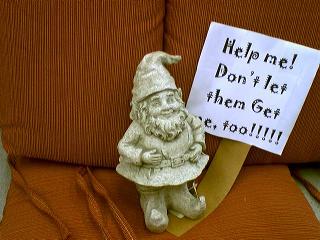
Your gnome, AKA "Target Dwarf Extraordinaire", was kidnapped recently by the Dwarf Liberation Army. We dwarfs have a major problem with garden gnomes acting like they are better than us. If you want to see your gnome alive, you must rendevous with our group one evening this week. We have attached pictures that prove your gnome is still alive and in good health. If you want him to stay that way, wear a cowboy hat to our meeting with you. You will receive further instructions soon.

(DON'T TRY TO FIGURE OUT WHO WE ARE, WE ARE WATCHING YOU . . . AND WE KNOW WHERE YOU LIVE!)

Signed, The DLA - See above for explantion of acronym"


STEP #2 "Proof of the villainy"
We sent the pictures (below) to prove to him we meant business.


STEP #3 "Throwing the victim off the scent of the trail"
I called Derek to make sure he checked his email. Immediately, he asked if I stole his gnome. I have an innocent face, which helped me in this conversation, and convinced beyond the shadow of a doubt, that IIIIIII had no idea what the "DLA" is.


STEP #4 "Derek notifies the police (ok, just his friends)"
Derek forwards the DLA's email to his friends and responds to the DLA's email:

"Wow! I'm intrigued, entertained and disturbed all at the same time!
(you can also throw completely puzzled onto that list) Thankfully I
do have a cowboy hat... though I'm leaving for panama city tomorrow
until Thursday afternoon for work... so please keep that in mind. I
can honestly say this is possibly the best e-mail I've ever gotten...
I suppose I'll await further instructions.

TDE-less Derek ...my little slice of the ghetto front yard just isn't
the same without him... please keep him safe! haha... whoever this is."

Signed, Derek


STEP #5 "Turns out Derek has more than one weird, sadistic friend"
Derek's friends, liking the fact that someone would be so weird to steal Derek's special Target employee garden gnome and taunt him (Derek, not the gnome), run with the idea.

Voice messages with smurf-like voices, claiming to the the DLA, flood his voice mail. He even receives another picture from a "copy-cat DLA" group (below).


STEP #6 "The culprit is revealed"
One week after the crime, Nadav and I, cowboy hat in hand and displayed clearly, arrive to breakfast at the Waffle House with Derek and find out the details of his gnome-less week. A moment before he leaves, I tell him that I have a present for him, Mr. Target-Gnome-Extraordinaire!

The evidence . . .

The first 4 pictures are those the gnome snatchers took and sent with the ransom note. The last picture was sent by an unidentified copy cat gnome snatcher.


Wednesday, September 06, 2006

Are we there yet?

"Map of Jerusalem" the sign on the sidewalk says. I pass by it while I am on the bus on my way home from the university. Suddenly a memory from 3 years ago rises from the ashes of my jumbled brain—the brain that now thinks in 2.5 languages (English, Hebrew, and a squeak of Arabic) and prohibits me from speaking any of them well. It was a Saturday night when my friends and I tried to make our way from the German Colony neighborhood to the center of the city. It was late, it was dark, but we had a native Jerusalemite with us, and we figured that improved our chances of success. We did succeed in arriving (finally), but during our adventure roaming different neighborhoods of the city, I remember coming upon a map such as the one described above and thinking that Jerusalem is a maze of streets, a labyrinth that I will probably never understand. And now, strangely enough, I do. To be honest, the streets—many of which are not labeled well—are probably the easiest part of the city to understand.

The sign I saw today hints at the complexity and yet also at the humor hidden in the stones of this holy city. "Map of Jerusalem" the sign on the sidewalk says. "But where is the map?" I ask. The side I see is blank. "Maybe it's on the opposite side." I turn in my seat in order to check the other side, and the sign answers my question with a smile and a shot glass. Instead of a map, there is an advertisement for Johnnie Walker Black Label Scotch Whiskey. "Well," I think to myself, "At least it's not Manischewitz."

So, where are we going . . . really? We have certainly not arrived to the place we want to be—the place perhaps, but definitely not the situation. Not everyone would agree, but I think one needs to know who and where he is before he can determine where he is headed. Is it possible that this is exactly the situation in which we find ourselves now, or for the last (insert your number here) ____ years? I think quickly about all the maps and plans that have been drawn, revised, burned, re-drawn, announced, voted upon, denied, agreed upon, shaken hands about, protested over, laughed about, and cried over concerning this piece of land and the fate of its peoples, and I wonder if it would have just been better to sit down with our neighbors and have a shot of Johnnie Walker. I know someone who thinks so—someone who was in war, who has seen wars, and who has had enough of wars at his tender age of 61. I've had enough at the wise age of 24. Maybe that is what it will take, enough 24-year-olds—not 60-year-olds—saying, "We've had enough." We have a problem saying it over whiskey, but perhaps with war, we know our limits.

Tuesday, August 29, 2006

Sunday, August 06, 2006

Sing me a death song . . .

I've often discussed with friends how I feel that I have a soundtrack for my life. It's composed of many different albums, artists, and genres--ranging from Frank Sinatra to Weezer to "Baby got back". I think most of us have memories that are connected to music, even those of you who cannot carry a tune and are forced to express your musical genius to the shower head and shampoo. We hear a song and it takes us back to a time, a place, a person.

Tim McGraw's "I like it, I love it", a country hit from the 1990s, makes me think of my best friend since middle school, Suzy, and the times we would sing it loud and clear on Friday nights in her bedroom. "Ride wit me" (yes, the Nelly CD found its home in my dorm room freshman year thanks to my roommate, Jada) reminds me of my first taste of true freedom--my first weekend at college--when Jada and I rode around town with the song blasting from the car and cat-calling guys for fun (as it turns out, we went to bed relatively early that night, despite all our plans to be wild).
And any, any, upbeat seventies song reminds me of my mother dancing around the living room, reliving her glory days.

What songs will I think of when I remember back to my first war? Well, I am listening to the radio now and Faith Hill, an American country singer just came on. A few minutes ago John Lennon's "Imagine" was playing--and as beautiful and contemplative as it sounds, I just don't think it's realistic. But I guess that is what is so special about music--like all art, it takes us away from reality for a bit, it helps us try to deal with the events in our lives. Music softens the blow of the sad, gruesome happenings of the world, and yet, it also has the ability to pinpoint the exact emotions we feel whether despair or happiness.

The songs on the radio now are, in general, calm. They could be love songs. They could be death songs. They could be songs you cuddle on the couch to or songs in the background in a house of mourning. I ask myself how it is that they can be the same songs--love songs and death songs. I think it's because they are both written about the important things in life. Why is love important? Because it brings meaning to our lives. Why is death important? Because it takes the physical expression of love--and the objects of our love--away. And in the case of a war, it takes it quickly, without warning, without mercy for those who are left behind. It influences the "atmosphere" of the society, if you can call it that. It plays a part in shaping the collective experience of the country--from the founding generation who fought wars until the current one who continues to do so. Songs of loss do not "belong" to any one country. Everyone--everyone--loses loved ones. But here, it seems a fate that is much too common and it is reflected in music, art, relationships, and everyday life.

Ten reserve soldiers were killed today. So, now, instead of thinking just about the parents and siblings by whom they are survived, we bring into the picture another generation--their children. These are men who served their time in the army when they were young men and have been called back as older men--to fight for their country, to fight . . . for what? I understand "the ideology". I understand why "we have to do this." I understand "what will happen if we don't." But at the same time, I understand nothing. Nothing.

There must be a limit to one's understanding of violence and hate in the world. If not, we don't have a chance. But, I guess, there are some people who believe we do.

For anyone who has lost someone, or simply lost his faith in humanity . . .

"Geulah" (Redemption) Chemi Rodner
Redemption, oh, redemption
Kiss me now, my soul
Women, they are words
They are living waters
Oh, redemption

The love between us will strengthen
And will become one day a grand silence
Like a spring . . .

Monday, July 17, 2006

That guy in the back of the church who never claps to the beat . . .

I could live without it, you know. All this fame. All this scrutiny. All this condemnation and threat and cameras and political commentary and social commentary and worrying about your friends and loved ones and calling just to ask if someone is ok and slow songs on the radio and traffic jams because cars have been directed away from an attempted bombing and . . . all of you worrying.

And myself worrying. Yes, that too. I could live without that.

I have had a few pleas to “come home.”
“If it gets really bad, you have to come home.”
“If you need to, don’t worry about the cost, just buy a ticket, get on a plane and leave.”
“Where are you? Not in Haifa, right?”
“Where are you? I hope it’s not Tel Aviv because Hizbollah has rockets that will reach there.”
“Where are you? Are you back to Jerusalem (where it’s safe?!?)?”

The easiest way for me to convey what I am feeling now is to say that my rhythm is off. I was walking around Hebrew University last Tuesday, and it seems that the architects who designed the otherwise beautiful (if extremely confusing) campus had legs of abnormal lengths. There are several staircases on the campus grounds that make you wonder, “Do I take two steps or one on every step?” And then I thought about the steps—they don’t seem to have a problem. They are built perfectly fine. But, then again, so am I. The old saying, “Marching to the beat of a different drum” comes to my mind. I see a picture in my head of a man wearing suspenders sitting in the last pew of the church clapping to the gospel song being sung . . . except his claps always come between everyone else's. The rhythm, to put it bluntly, is off.

Last week, it was the university steps and the idea seemed lighter to me--like the suspendered man. Now, it strikes me as heavier. Why? Because it is life. Perhaps the dissonance I felt in the steps was a premonition for the violence that would erupt in less than 48 hours; perhaps a foreboding of the awful rhythm of life that would be created by it. People are coping, but they are acting strangely—even all of us here in safe Jerusalem. We are not being bombarded by thousands of katushya rockets. The sun is shining. The birds are chirping. But life—which was previously lived to a rhythm of falafel and avoiding traffic accidents—now follows the metronome of hourly radio newscasts that bring us news of more fear, more danger, and more injuries.

I’m not scared. Israelis have never been under the impression that “all is clear”, that there aren’t more than a few people who would rather we not be here. But I’m sad. I’m so . . . sad. It seems like the goals I have in my life—to create and promote positive interactions and peace, to have an open mind towards other cultures, tikkun olam (making the world a better place) in short—have no chance in a world with people like those in Hamas and Hizbollah.

I don’t want you all to be scared, to think that I walk to work through a trench lined with barbed-wire. I’m ok. And, statistically, the chance that I won’t be is very small. I cannot imagine what all of you are feeling when you read and see the news. I know what it is like—how CNN, Fox, and ABC portray what Israel is like/not-like/doesn’t like/etc. It’s not so long ago that I lived in the America. But I didn’t have a loved one here. If I were there now, in America, I would. I would worry as much as, if not more than, I did when Hurricane Katrina hit the US and I wasn’t there to see with my own eyes that my family was allright.

I’m wondering, with the “current situation” (as Israelis like to say), if my career as a comedic writer is over. I hope not. Actually . . . I know it’s not. Things will get better. When and how remains to be seen, but they will get better. And there will always be a need for jokes about backwards clothes, doctors who sing Disney theme-songs while operating, and the never-ending antics of Becky Feinberg.


Also, I know it’s no man missing teeth talking about how it was to ride through the tornado in a trailer . . . but I was on the news. Well, it wasn’t actually me—it was my house. Well, it wasn’t exactly my house, but it was my intersection. And it didn’t actually happen in my intersection, but for that, I’m grateful.
http://www.jpost.com/servlet/Satellite?cid=1150886023917&pagename=JPost%2FJPArticle%2FShowFull (Please note, that I am just using this link so you can see where I live—the article does not go with the picture, so trust me on this one--and remember, the news always presents what it wants you to think! The attempted bomber was caught further away.)

Friday, July 07, 2006

Kris Kross Will Make You . . .

I think I just realized what this whole blog thing is about--to whine and complain. Oh, sorry, that's just what most people do on their blogs (and at home, and at work, and in the supermarket line, and . . .the list goes on). I've managed to keep it under control this last year and half since I started my blog and perhaps to a lesser extent since I moved to Israel. Perhaps it's my naturally sunny (read: denial-focused) nature that allows me to be so positive.

In any case, since I haven't written in a while, I thought I would tell you about some of the nice things going on in my life.

1) Today, one year after receiving the skirt I am currently wearing, I am finally wearing it correctly. That is to say, I received a hand-me-down skirt one year ago and have been wearing it backwards (proudly, I must mention) without realizing it. When it was first pointed out to me a week ago that I was indeed wearing it backwards, I said to myself, "I am such a dolt!" (I didn't actually say this of course, because I am not really sure what the word dolt means, and not wanting to be a true dolt, I just thought it) But then, my positive nature taking over, I thought, "But I've received so many compliments on this skirt." And that is when I realized that maybe we're all a little turned around in our lives, and I was the only one expressing it outwardly. Who knows? Perhaps I'll start a self-awareness fashion trend.

2) I finished my first Hebrew novel, "Arba-ah Batim v'Ga-a-guah" (translated something like, "Four Houses and Longing"). Now that deserves a party--a big one--with LOTS of people wearing backwards clothes. To celebrate, I bought Amos Oz's "A Tale of Love and Darkness" (in Hebrew). Don't worry, by the time I finish this one, we'll all be living on different planets in the galaxy drinking moon juice and I won't expect you to come to the party.

3) I'm finally going to start my master's degree this fall. That is exciting. Three years after finishing my first degree (Israeli English for "Bachelor's"), I am going to delve into the world of academia once again. Let's hope I can handle it. Let's hope they can handle me! After a bit of confusion, I WILL be pursuing my MA in Political Science. The degree is in a specific track called "Democracy and Citizenship Studies." One day, with a lot of effort, a little luck, and a lot of Cheetos, I will be Becky Feinberg M.A. I guess it's just not the same when it's an "A" instead of a "D".

Other than that, I'm still dating my wonderful, patient, funny (because he understands my jokes! finally someone understands my jokes!), and sweet boyfriend, Nadav. We, G-d willing, will be visiting the Redneck Riviera (I say this with the utmost respect and longing for my beloved birthplace) at the beginning of October. If you are in the neighborhood, we will meet up. I'll be the one wearing the backwards skirt.

(If you somehow missed the giant rap duo of the early 90's, Kris Kross, please note that they wore their clothes backwards--that is about the extent of their talent)

Monday, May 15, 2006

Dwarf (Sized) Pickles and Random Moments . . . . Hosted by Becky Spice

The title of this blog almost doesn't need more explanation--at least not to be funny, that is. To be understandable, perhaps it does need a bit more. Dwarf-sized pickles. It sounds like the name of a teenage garage punk band, right? A kid named (or rather, nicknamed, much to his mother's discontent) "Bonehead" turns to his friend "Munchies" and gives him a high five, "Way to come up the name, man." "Yeah . . . . mannnnn."

But the truth is, you cannot make up this stuff. I ate a dwarf-sized pickle last week, really. I had no idea when I bought the jar or even after I opened it and tasted them for the first time. It was only on Tuesday as I wondered to myself, "How do you say mini-gherkin in Hebrew?" did I look at the label. Turns out it's, "Dwarf Pickle." Well, I guess you could say then that my addition of the word "sized" to the title is just my commentary or hopeful thinking. I can imagine that most people would rather imagine these pickles are made for dwarfs or at least a company makes fun of their size rather than actually being made out of them. Well, that is what I am hoping. I would rather my pickle company be a cruel kid in fourth grade making fun of the short kid (come to think of it, I think I was that short kid) than a cannibalistic cult who for some reason has decided that eating small, mystical creatures from the Lord of the Rings is better than eating normal sized human beings.

That is one funny thing from my week.

What else happened? Oh, yes, I apologized for bumping into a mannequin. It's actually more correct to say that I apologized to the mannequin. I felt pretty good about myself for saying, "Excuse me" in country where short people with canes (not dwarfs, old people) hit your shins and run over you get on the bus. You do hear "Excuse me" a lot in Israel. But there is also a noticeable silence many times when the expected "Sorry" or "Excuse me" floats into the universe instead of coming out of someone's mouth. In any case, I felt pretty good about myself for being polite . . . that is until the bastard stared at me in stony silence. Let me just say, "I can be Israeli, too." That's the last time I say excuse me to a store mannequin.

That is another funny thing from my week.

Ah, yes. I was the star of a horror movie last Monday. Monday, thank goodness*, was a very warm day. *Note: I said thank goodness until I became the star of a horror movie. Now, I say, "Monday, oh-my-freaking-G-d-I-think-I-almost-died-from-disgust-and-heart-failure, was a very warm day." As I was saying, spring finally came. How lovely. Spring. Birds chirping. Kittens (400 of them) being born on our little street. Flowers blooming. Oh yes, and invasions of bugs. Invasions of LOTS of bugs (it is important to mention that they were not dwarf-sized). Not outside. Not even in the hallway. In the bedroom, MY bedroom, on MY B-E-D! One minute I was speaking on the phone and the next my wall and bed were covered by tiny, flesh-eating (well, not really) insects all trying to make their way to me (maybe I'm being egotistical here) and not stopping even after I attacked them (my killer instincts have sharpened since my TWO encounters with hand-sized spiders in my room). The boogers (there is no other word for them but this favorite Southern-ism) were out for blood. So, I did what any respectable girly-girl would do--I saved my Popples (if you have to ask what this is, you have missed a fine generation of stuffed animals) and headed for the hills. That is, I sprayed the room, closed the door, and slept in my roommate's room. Thank the Lord this was a one-time (I hope) occurrence. After speaking with several Israelis on the topic, it turns out that every spring, on the first very warm day, thousands of bugs stream out from their holes in search of the season's first falafel. It's like Groundhog's Day, except Poxatawny Phil is not as disgusting (who ever thought you could say that about a furry, tunnel-dwelling rodent?). They come out, scare innocent girls like myself, and leave (perhaps for Bermuda). Now I am armed for WW3 (not as funny of a joke here in this part of the world). I've got Raid, I've got a BZZT light (you know, the light that goes "BZZT" when the bugs fly into it), and I bought Popples an African bush hat with a net. WE are prepared here in room number 4 at address Ezrat Yisrael 15.

That is the third funny thing that happened this week.

The fourth is that I walked out of a soup restaurant (where, ironically, I did NOT eat soup--I know, I'm so avant garde!) and was run over by a marching band. It was 9pm at night, I was a bit tipsy from my hot chocolate (not really) and out of nowhere comes a group of eight or nine traveling minstrels, playing none other than "If you wanna be my lover" by the Spice Girls. It was weird (perhaps also a bit sporty and posh if you know what I mean), very weird.

I'm sitting here on Monday afternoon, wondering if I'll go out tonight for all the bonfires (In Israel, on Lag B'Omer, we celebrate by building really . . . really big fires). I think about all the random things that happened to me last week, and I wonder if it was any stranger than any other week. I think I'll have a dwarf-sized pickle and contemplate life for a bit. Or maybe just the possibility of a Spice Girl called "Dwarf Spice" . . .

Friday, May 05, 2006

There's No Place Like Home

I've decided to do a master's degree in saving the world--graduate studies in making the world a better place. Do you think I'll graduate with honors? Do you think that my dissertation will get published? Or will it get thrown into the trash, or if I'm lucky and I've changed the world a bit by the time I finish my MA, the recycling bin?

From the time I was young, I knew I cared about people. December 25, 1989--this date marks my first act of social change. I volunteered with my father and members of our synagogue preparing Christmas dinner for homeless individuals and those who simply needed something to eat on a cold, winter day. I thought about the home I would return to after we finished carrying the big vats--or, for me, a small vat--of green beans and mashed potatoes to the large tent where they would eat. I thought that it was strange that even though I was Jewish, I was probably having a warmer Christmas than they were.

I was seven years old, and even then, I knew that some people in the world do not have enough to eat; some people do not have enough money to pay for heat; and most importantly, some people do not have anyone who cares enough to help them do something about it.

When I was six years old, I wanted to do something about it. Eighteen years later, I still have this desire. Now, however, my thoughts on social change are more extensive. I know what the “it” is; I can begin to imagine what “doing something” means.

So, I've applied for a master's program in Democracy and Citzenship--a program where the focus is how to change the world--knowing that education is not the only action needed but that it is a good place to start.

As my application is processed and I simply wait for my interview with the admissions committee, I think about the homeless individuals I've encountered the last couple weeks of my life. Beyond my daily encounters with truly homeless people in downtown Jerusalem--those who sleep on the sidewalks and beg for change from tourists, from Israelis, from anyone who is willing to give--I think of others.

Where did I spend my Passover seder? With women and children. Not so different that most seders, except that they were in a shelter for people who can't go home. Why? Because they don't have a home. Home for me, for most of us, is a place where one feels safe. If we define it that way, then they are homeless. They are in the shelter in an undisclosed location because they are escaping abusive husbands and fathers. What may have been--or may never have been--their homes were places where nobody felt safe, where violence and threats were the norm, where punches and yelling replaced embraces and kind words.

What's been in the news the last couple of weeks? The week of Passover, nine people were killed in a bombing in a falafel shop in Tel Aviv, more than fifty injured. What now for the spouses who lay in half-empty beds, staring at the dent in the mattress of their loved ones who will never return? Have they yet stopped making the extra cup of coffee in the morning, realizing that there's no need, that there isn't anyone to drink it? Is this a home? Or just a premature casket to live in for the next 50 years?

What else? A man murdered his wife--and then killed himself--leaving five children behind. What else? A man murdered his wife--and then killed himself--leaving two children behind. Yes, twice, in the span of a week. The children are taken from their homes, maybe to an aunt's house or maybe to a foster home. But is it home? Is home without your parents, without your loved ones, really a home?

I met a man last week who was arrested for trying to get into Jerusalem to get his medicine from a doctor and receive some money that had been donated to his family. He was arrested--released in the end--but still put in a holding cell because he didn't have the right paper work. He lives 10 miles away from me. How is it that his home is so different than mine? How is that the place he has called home his entire life is not considered his home by others?

And now, I think about myself--about my "home situation." I have a home where I grew up. And I have a home here. Does having more than one home mean you are lucky, or is it a curse of a different kind? Am I, too, homeless? But it's not acceptable for me to say this, for me to even think this way. The sacrifices so many before me have made to make my life easier, happier, more complete prevent me from even dwelling on the thought. I think of the soldiers who are fighting wars that will hopefully make the world a little safer. And when I think a little "closer to home," the numbers I heard this week arise in my thoughts. The almost 21,000 soldiers who have died defending Israel. The 83,000 who have been totally incapacitated as a result of the wounds they received during service. The millions more who have willingly put on khaki green and beige and navy blue to fight for their right to exist, to live in a place that is (even if not exclusively) the home of the Jews.

Tuesday was the Memorial day for Fallen Soldiers and Victims of Terror, and I attended a program where we discussed our different experiences of this powerful day in Israel. One of the phrases that came up numerous times was "how lucky we are to be able to be here," in essence to have a Jewish homeland.

Even if there are abusive parents and murder? Even if there are bombings and discrimination? Even if there people sleeping on the streets? Yes, even if there are all of these things and more, it's our home. And we'll quiet the noisy children. We'll fix the broken shingles. We'll make it so that one day, every one gets a seat at the dinner table.

And I hear the question already: "And if we don't succeed?" The answer is that in many ways, we already have and-- "And if don't succeed?" it interrupts my answer mid-sentence. The answer is that there is no choice, we will.

Sunday, March 05, 2006

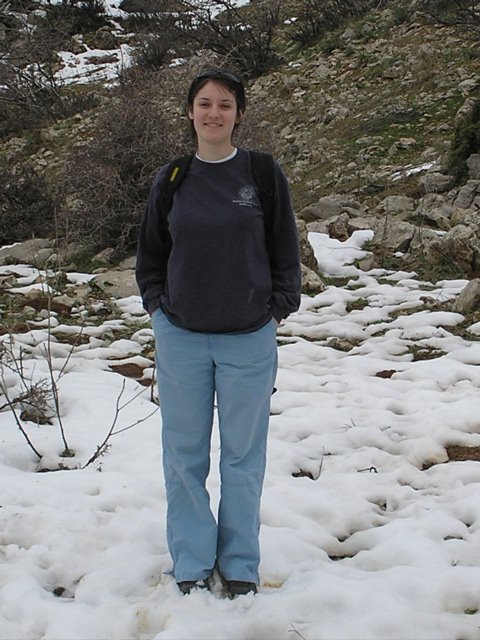
Becky on Mt Hermon Posted by Picasa

Sunday, February 26, 2006

Wrestling with Tigers

Israel. It means “wrestling with G-d,” something I anticipated doing when I made aliyah. After all, I live in the holy city of Jerusalem. I didn’t, however, anticipate wrestling with tigers, another experience afforded to me here in my humble abode.

Yesterday was my one-month anniversary of freedom. One month ago, I was released from the Bikur Holim hospital** in Jerusalem, Israel. One month ago, I walked home from the hospital, hunched over in pain and ready to lie down from my long journey—the one block home from the hospital.

Being in the hospital can work wonders on your life (and your appendix). My hospital story goes like this . . .

December 29th, 2005, I flew to the United States for my brother’s wedding.
January 20th, 2006, I set foot in Israel again.
The Sunday after my arrival, January 23rd, I woke up in the middle of the night in more pain than I’ve ever felt.


The scene: 1am, Becky’s Bedroom, where sugar plum fairies dance to the bass rhythm of Nadav’s snoring and Becky rolls over once again, holding her stomach, and promising G-d that if it the pain stops, she’ll never again eat tomato-cream sauce and chocolate cake in the same meal, for real this time.

“Nadav . . .”
“Mrrmpght . . .”
“Nadav?”
“Yeah?” (sleepily)
“I’m really hurting . . .”
“Mrrpghth”
“Nadav?”
“Yeah, can I do something? Do you think you should go to the hospital?”
“Maybe . . . I’ve never had pain this horrible from eating a bad food.”
“Ok, (mmrthphopth) I’ll call my mom (she’s a nurse).”

After describing my symptoms in several languages, it was decided that I should go to the hospital, with a likely case of either food poisoning (my bet) or appendicitis (Nadav’s mother’s idea). After succeeding in waking my soundly sleeping roommate, we asked which hospital to go to. “Anywhere but Bikur Holim,” she replied. (See starred name of hospital above for comic relief and the set-up of the continuation of this story)

So, we walked the 300 yards to . . . Bikur Holim. We didn’t know where the ER was, so while Nadav ran to find it, he asked some guys walking down the street at 2am to “watch me.”
“Becky, these guys are going to watch you?”
(Note: I forgot my glasses at home)
“What, you’ve asked random guys walking the streets at 2 am to ‘watch me’?!? Have you lost your mind?”
As they got closer, I saw heard American English and saw they were 19-year-old yeshiva kids, coming home from a night at the bar. “Ok, fine, just hurry,” I replied and tried not to look like I was dying.

We made it to the ER and what Nadav anticipated being a “walk-in-walk-out” visit (his later justification for taking me to the only place UN-recommended by my roommate) became a hospitalization, a surgery, and a scar the size of the Eiffel Tower.

My hospital room, which was a steamy 102 degrees Farenheit, housed, not native plants of the tropical rainforest, but rather an old religious woman, a survivor of Auschwitz, whose first language was Yiddish and who snored like a lumberjack. She was in need of a pacemaker and heart medication, and before she would agree to either (in the end, she agreed to neither), she needed to check with her rabbi. The third occupant was a religious woman who—like me—was also having stomach pains and who—like me—waited an inordinate amount of time for an ultrasound. My final roommate was a Muslim young woman with a broken nose, who, so sweet and quiet, cried in pain until a nurse found her and chastised her in Arabic, “Why didn’t you tell me you were in pain?!?”

To enrich your vision of the scene, remember, I was in the “Surgery Ward,” which means, “Everyone is fasting in preparation for surgery (and so therefore weak and falling over) or everyone has already had surgery (and so therefore drugged up on painkillers and falling over). Please note that all over the world the usage of hospital gowns that bare your ass to the world when you are least prepared to handle the situation is encouraged.

To further enrich your image, let me just tell you right now, that there are lots of things in Israel that on the cutting edge of technology. Bikur Holim hospital . . . not one of them.

Enter . . . . my doctors (not one of which was born in Israel, America, England, Western Europe, oh forget it, anywhere but Russia)

I guess my real question about my doctor is . . . why did he seem so professional when explaining to me the necessity of an appendectomy and having me sign the documents, and as soon as I agreed, he turned into Binky the Clown?

“Did you make pee pee?” he asked me, after my first round of injections of anesthesia pre-operation.
“No, I forgot.”
“Ooops, you’re going to have to use a bed pan.”
“Urgh.”
(Becky using bed pan to the background music of “The Pee-Pee Song” performed by Surgeon Binky)
“Oh, G-d, this is the guy doing the surgery . . . . this cannot be gooooo . . . wow, that feels good . . . why is this mask over me . . . woooooo”

Awake.
Hell.
Pain.
Cold, freezing, shaking visibly off the bed, PAIN.
Rambling in Hebrew, English, Jibberish.
Throat burning from breathing tube being ripped out while conscious.
Lips burning from tape being ripped off while conscious.
Tears streaming, body convulsing, lungs bursting, flashes of roommates, friends, my love, touching my hair, my legs, lights dimmed, beeping, beeping, beeping, sticky, everywhere. Sleep.

Morning. I’m alive. I feel like I’ve been run over by a bulldozer, but I’m alive. Nadav slumped over on a cot the length that he was when he was 4 years old. Can’t move without his help. They’re telling me I have to urinate. But I haven’t drunk anything in 36 hours, eaten anything in more. “Well, you really need to. Let us know when you have.” “Okkkkkkk . . . ”

And that, as far as I can tell, is what being in the hospital is about. Everyone caring about your bodily fluids, etc. They wouldn’t let me eat for two more days, but they somehow expected me to do, well, the impossible. I wanted to explain that theory of matter we learned in sixth grade, something about matter not being created from nothing. But, I was on painkillers, which means I basically just sat around reading, sleeping, getting my cell phone stolen, and walking to the bathroom propped up by an IV stand while trying not to let people see my ass.

And then the day I was able to do number #2 (you know what I mean), they let me go. I got out alive. I felt better. I feel better. I do wonder why in a city that has wireless internet in its entire downtown and each person owns two cell phones they didn’t use micro-surgery, why I’m left with a two-inch gash for which the only response I have is, “Well, you should see the tiger I wrestled with—now he looks bad.” But, I’m ok. I made it out. I saw the concern in my friends’ eyes. They saw the appreciation in mine. And I came to realize what most people who make it out of the “darkness” of anesthesia and surgery realize—that wrestling with tigers is like wrestling with G-d. You come out knowing what’s important in life, even if they did forget to give you your appendix in a jar.

Thursday, November 10, 2005

I'll Be a Millionaire in No Time

I guess I just didn't think I was worth that much. I'm not referring here to my self-esteem. I'm talking about my "marketability" in the job-world. Perhaps, because it was my first "real job," I was willing to settle for less. 23.75 per hour sounded good. For all you Americans reading this, remember, I'm talking shekels here, not dollars. I won't outline the exchange rate for you here, because, well, then you'd get just as depressed as me about how little I was earning. One of the common things you hear when you move to Israel and start working is, "You can't compare your Israeli salary to what you were earning in your cushy American job." Let me just be honest, though. I was never in what one would call a "cushy American job." Most of my amazing career opportunities in America were in what we in the food service industry like to call "The Culinary Arts World." My venture into this career arena first began at the tender age of sixteen. I had my whole life ahead of me. I had a new (and by new, I mean, 1988) Chevy Cavalier. It was the summer of 1998, or as I like to refer to it, "The Summer of Dreams," and--as I found out soon enough--Big Macs. I landed myself a prime position in a world-famous gourmet restaurant. I haven't been all over the world, but I've done enough traveling to know that this fine establishment is indeed world-famous. Where there is human being with a craving for french fries (or "chips" as some of the world calls them) there will be the illustrious golden symbol of capitalism and globalization. Yes, McDonald's.

At McDonald's, I learned a lot. First, when a supervisor asks you what your availability is, do not ever say, "Whenever," because "Whenever" could--and did--mean 5:45 in the morning . . . every day of the week. Second, there are a lot of mean people in the world who are just looking for some sweet high school girl on whom to take out their anger. Third, there are a lot of high-school girls in the world who are much smarter than most of the customers who frequent McDonald's. And fourth, earning minimum wage sucks.

I've been in the work force now for over eight years (ten, if you count my foray in the world of landscaping--a very dangerous profession I might add*). Eight years, and I am now earning per hour . . . what I earned as a sixteen-year old working at McDonald's. It's thrilling. I love to speak on the phone to my American friends and hear them complain about their entry-level salaries. I usually just smile, grit my teeth, and commiserate with them, "Yeah, it does suck," while continuing the thought in my head, "That you are earning twice as much as me."

The saying is true; you cannot compare Israeli salaries to those in America. However, the ideas that "The exchange rate compensates for the lower salaries because of . . . " and "The prices on everyday commodoties is lower because of . . ." are simply not true. Yes, I pay very little for rent. But I also have two windows in my lovely room--one at the top of my 15 foot ceiling and one--yes, I'm being honest--that opens to the kitchen. Yes, I pay $160 rent for my bedroom, but I have a washing machine in it. Yes, I pay comparatively little rent . . for my cozy (read: small) room in an apartment with 3 other girls. But, on the up side, the real estate market is looking up in my downtown Jerusalem apartment. I have a room that constantly grows because the paint chips and the sand walls fall down daily. And if you're a polar bear, it's a prime location (no heating in the winter!).

It may sound from all of this that I'm having a hard time--in work, in my living situation, in life in general. But it's actually quite the opposite. In work, as you may have gathered from the title of this essay, I just received a raise. It was an exercise in evaluating and valuing my self-worth and, additionally, in becoming an adult. Asking for a raise is no easy task, but my discussion with my boss was less painful than I anticipated, and she was happy to offer me five more shekels an hour.

My living situation, although the description I just gave sounds less than pleasant, is actually great. I love my roommates, and they love me (and the washing machine I brought with me when I moved in). My apartment is conveniently located to everything, and I have a variety of bakeries within close (perhaps too close) walking distance. Additionally, I roll out of bed in the morning (roll, rather than get up, you just read the part about the bakeries), walk 100 yards, and I'm at the bus I need to go to work every morning.

In addition to that, I guess it's time now to reveal the big secret: I'm . . . ha ha . . .just kidding. I'm not getting married. I'm not pregnant. I'm not moving to China. But I am dating an amazing guy named Nadav. We've been friends for quite a while, and about two months ago, each of us decided that the other is pretty cool and perhaps worth a shot. (By the way, I'm cooler than he is!)

In any case, life is good. And with my new five shekel per hour raise, I'll be a millionaire in no time. In fact, because of the exchange rate (4.5 shekels to the dollar), I'll even get there 4.5 times as fast. And don't worry, when I move in to my mansion, you'll be the first to know.

*About landscaping being a dangerous profession (for those of you who don't know the story), I'll post an educational essay soon about lawnmowers, engine belts, and how NOT to stick in your hand in them.

Thursday, September 29, 2005

I'll see you tomorrow . . .

I am constantly amazed at the scenarios and the people that I encounter on the bus here in Israel. It seems like every essay I write is somehow influenced by my bus travels. I think it’s because on a bus, you simply have time to think. And watch. And hear. And see the same things over and over again. And realize that sometimes the things that you think are distanced from you are in fact the every-day, well-known, well-loved bits of your life.

My morning starts with the smell of ______. I would like to fill this blank with a variety of nice-smelling things--coffee, doughnuts, flowers, vanilla--but in fact the answer is . . . old urine. While my house is situated on a beautiful side-street with flowers, grapevines, and enough cats to film another segment of “Planet of the Apes” (except with cats, of course), my bus stop leaves a bit to be desired. It’s next to a parking lot that people seem to have mistaken for a public restroom. What I realize each morning as I stand in the place as far away as possible from the smell (Note: This location changes each morning depending on wind speed and direction) is that my life is filled with people whose names I don’t know.

The first two people I encounter each morning after leaving my little street are a Philipino man and a cranky teenage girl.

The Philipino man wears a baseball-cap and he’s a caretaker for an elderly religious man. He hasn’t told me, but I’m sure that’s what he does. Here in Jerusalem, that’s what you do if you are Philipino. You care for elderly religious Jews with money. You spend your days speaking English and your nights off speaking Tagalag.

The teenage girl, well, she’s a bit more of a character. She--in all her I’m-too-cool-for-this-place glory--has the ability to gross me out anew each morning. You see, she likes to wear her pants too big--hanging down over her shoes--and think she’s somehow original for a high-schooler. The part that grosses me out is the bubble gum that she chews. I think she first sees the scared look on my face. Then, and only then, does she pull the saliva-covered hot-pink gum from her mouth and begin to twirl it around her fingers, swinging it around and around and around. With each revolution, the look on my face exhibits more disgust. Eventually, I turn away and see the bus (Wait! My bus!) pass me without stopping.

The next person I meet, or in this case fail to meet, is the bus driver who passes me by without stopping if I’m not standing exactly next to the urine-smell bus stop. He’s--how should I say this?--not exactly my friend.

In the next 14 minutes, while I wait for the number 7 bus to pass again, I do one of two things:
1) Respond, “Fine” to the obligatory, “How are you?” asked by the male twenty-something bus security guards who speak only to men with dark skin or girls between the age of 20-27.
OR
2) Say, “I’m sorry, I don’t speak Russian” in both Hebrew and English to the Russian-speaking individuals who stop to ask me directions and because of my complexion and appearance assume that I too am from the far reaches of Moscow.

I board the number 7 bus eventually and see my favorite driver. At the next stop, the two blonde supermodel types (Are they Swedish?) get off at the stop near the shuk (open fruit and vegetable market). There’s a chance they are doing a photo shoot at the market, but unless raw fish and falafel stands are the up-and-coming place for photo shoots in the modeling world, my guess is that they are the common German-tourist volunteers and they are working in the soup kitchen there.

As we stop near the market, a black-clad religious man and his school-uniformed daughter board the bus. They are loaded down with plastic bags full of fruits and vegetables. As we pull up to the central bus station, one of the stops on the route, an onion rolls past me and a woman in seat facing the back positions her feet and blocks it with the ease of a seasoned soccer player. I see she’s played “Shuk Onion” before.

The next person of interest is the religious man with Down’s syndrome I see waiting at the stop at the beginning of the ultra-religious neighborhood we drive through on my way to work. I don’t speak to him. We don’t even ride the same bus, but I can’t help but wonder where he’s going every morning.

Suddenly, a grapefruit hits my foot, and I look up just in time to see my favorite person on the bus--a little baby being swung around by his loving father as if he’s a tennis racquet. He’s by far my favorite because, well, he wears the best kind of pajamas invented (the kind with the little footies), and he sleeps through everything as we make our way through speed bumps, construction, school children, and more.

By now we’ve reached the next to last stop of the route, and everyone but me and the guy who’s fallen asleep gets off. The driver talks to himself, now that there is a bit of quiet. Once, he looked up in surprise when he saw me sitting in the back. By now, he knows I’m still there, but I guess he trusts me enough to reveal his secrets.

As I get off the bus, making sure not to forget my packed lunch in the seat next to me, I think to myself, “Am I ready for today?” I think, “Where did all those people go? What are they doing?” And then I think, “How would they describe me--the girl whose name they don’t know?”

She’s the girl who wears the silly glasses, who sits listening to her MP3 player. The girl who smiles when she receives a text message from her new boyfriend, the girl who is making her way to work in an English-speaking microcosm in this crazy little country. She wore an orange backpack until the zipper broke, and now, she’s changed for something a little more toned-down. She’s nice enough. She’s calm enough. She’s pretty enough. She’s . . . well . . . we don’t know her name, but that’s ok. We’ll see her tomorrow.

Tuesday, August 23, 2005

Finding the Peas in the Pea Soup

I once read a bumper sticker that said, "World Peas." Get it? World Peas=World Peace. I think it was meant to be joke. It's not that I've lost my sense of humor here in Israel, but sometimes I feel like it's easier to find "peas" here than "peace."

My sweet Israeli boyfriend told me that I need to calm down. It's kind of funny actually that an Israeli--someone from a country where old ladies beat you up in supermarket lines--would tell me--calm, little, American me--to calm down. I was moving to a new apartment, and the moving guy (ie Lucifer) was giving me an extremely hard time because, well, if you haven't noticed:
1) I'm a girl
2) I'm not Israeli
3) I'm someone who hired an Israeli moving guy and therefore agreed to an unspoken contract that I was looking for someone to verbally, mentally, and financially abuse me.

So, I basically told him to quit being such an ass. Turns out that was NOT a good idea and he threatened to quit on me in the middle of the move. I had to backtrack, and I learned a serious lesson: You can THINK someone is an ass, you can even whisper to your dog, "Hey, this guy's an ass!", but if someone has your bed, closet, and underwear in the back of his truck, you shouldn't tell him outright.

Anyways, the move went fine. MY move went fine. But this past week, if you haven't heard the news . . . for the last 16 months . . . there are a lot of other moves happening here in Israel. The disengagement started last week. Jews living in Aza (Ie The Gaza Strip) and the Northern Shomron (Ie The West Bank) received their eviction notices, and were moved--some more willingly than others--to new places (places, because they may not necessarily be homes) inside the Green Line. For the last 6 months we've been bombarded with posters, ribbons, bumper stickers, even buses that say: Jews do not expel Jews, Sharon is a Nazi, The Disengagement is another Holocaust, The Disengagement is worse than Pea Soup, etc.

I've seen them all. And I think I've found my favorite. First you need to understand that "Yehudi Lo Mi-garesh Yehudi"= "Jews do not expel Jews."
Now you can understand my favorite poster (reminiscent of "World Peas"):
"Yehudi Mi-karev Yehudi"="Jews bring other Jews closer"

It's a play on the popular statement in rhyme and meter.

It doesn't really translate well, but let me take on an imaginary tour of Jerusalem. There are parts of the city where if you show your shoulders and knees, you may get a rock--or at least a dirty look--thrown at you. There are parts of the city where you can buy pork. There are parts of the city where everyone on the bus is muttering prayers and Bible verses beneath his breath. There are parts of the city where you'll only hear Russian/Arabic/Hebrew curses being muttered beneath someone's breath. There are parts of the city where no head is covered by a kippah, a wig, or a black hat. There are parts of the city where when you get on the bus, the combined worth of the wigs you see women wearing is larger than the national debt.
So the idea of a Jew bringing another Jew closer--and let's be honest--in a place where sometimes the only reason you want to do that is to strangle the other Jew is a great idea. The poster shows two men:
1) facing away from the camera
2) with their arms around each other.

Both of these things speak truth. First, that we're really not all that different from each other. Religious Jews and non-religious Jews. Russian Jews and Middle Eastern Jews. Jews and non-Jews. Dare I take the leap and say even Jews and Arabs?

But the second part also makes a statement. Perhaps the intent of the the anonymity of the pictured men is meant to convey, "This could be anyone, even you." However, with the current situation always in mind, the idea I take from it is more along the lines of, "You can cross the line, but only so far. You wouldn't want to actually be labeled as someone who does ____, would you?"

And THAT is the crux of the problem. It's not necessarily exactly what someone thinks, but rather how he acts. I'm a firm believer in the idea, "Good intentions pave the road to hell." One can do his best. And it IS important. But how someone acts--how far he goes to prove his conviction--is more important. Let's take parenting as an example. If a parent wants to teach a child the lesson that stealing is wrong, he must first, not steal himself and second, punish the child if he steals. If a parent wants to teach a child not to be racist, he must first, not use racial slurs, and second, discipline the child if he does.

And if a state wants to prove that it is indeed a democracy and cares about equal rights and the rule of law, it must . . .(and here we arrive, finally, to my opinion on the disengagement from Aza):
1) make painful concessions even in the face of a nationalist/religious ideology that argues against them
2) show the world, but more importantly the unfortunate and perhaps even unintended victims of its policies, that it is willing to "put its money where its mouth is"
3) take a step to change the status quo.

Stagnance is perhaps one of the worst problems facing social, political, and economic systems in the world today. One would not argue that a fascist party staging a revolution to overthrow a democratic regime is a good idea simply because it is change, but let's revert for one moment back to the World Peas idea.

My question (perhaps a silly one) to all of you is: Do we actually see the peas in pea soup? That is to say, do we see the parts that make up the whole? If we begin to, and I have, it then becomes impossible to say, "But what about the terror that will inevitably come after the disengagement," because you know that one of the "peas" is a little kid who would much, much rather play soccer than learn how to throw a molotov cocktail. It becomes impossible to say, "But it is Jewish land," because you see each one of the 1.8 million "peas" that lives in one of the most crowded areas in the world, and then you see their Jewish counterparts' villas. I wouldn't say I'm a leftist. I'm simply say I'm for World Peas and all the other vegetables out there.

Wednesday, July 20, 2005

Random Babies, or How I Learned to Stop Worrying and Love the Bomb

I cracked the other night, and by "cracking" I mean I burst out in laughter. It had been a tense week, during which I constantly thought about the following topics:

1) Find a new apartment
2) Find a replacement for old apartment
3) Arrange discount for city taxes
4) Visit advisor at university
5) Think about the fact that in less than 3 months I will be starting my master's degree in a foreign language
6) Work
7) Find apartment for my friend
8) The disengagement from Gaza and how I feel about it
and
9) Deal with the fact that there are not 1, not even 2, but no less than 4 guys who are interested in me right now

That, number 9, is what made me break and let out the laugh that brought me back to the ridiculousness of reality.

I titled this blog after the movie "Dr. Strangelove, or How I Learned to Stop Worrying and Love the Bomb" because I realized two things today. First, I considered the possibility that perhaps I am NOT, by nature, a relaxed person. Second, the "bomb" that is life in Israel can make you a little stressed, and you're entitled to be that way. In the past, some of you may have gotten the impression of me that I am in fact a relaxed person. Well, it turns out that is one side of my personality. Luckily that side is usually in control. But, for instance, this morning when I woke up at 6: 30 am to arrive at the City Municipality to arrange for a discount in taxes (a feat more difficult than climbing Mt.Everest), arrived and found out that, for some reason, TODAY (of all days) they were not accepting applications for this, I muttered a few expletives and the other side came out.

I think you can give into this other side sometimes--it's healthy. But you can't let it control your life, your actions, your ideals. The thing that comes to mind right now is the disengagement, of course, because this is the only thing you seem to hear or read about these days. I think about how Israeli culture is one that flows, has an undercurrent of "It'll be ok." However, it is not this attitude that is shaping the country right now. It is the other more tense "We'll fight for our ideals even if it means dividing the Jewish people" attitude that is controlling our political ideologies, our outward political statements, even our attire.

Living in Jerusalem, one is bombarded (I suppose this is a very left-wing stance to take, for if I were more right-wing I could say "encouraged") by the color orange. Orange, for those of you don't know, is the color of the "revolution" (after Ukraine's recent political upheaval)--the fight against what seems to be the inevitible evacuation of Jewish communities in the Gaza strip. But it is exactly this doubt, or perhaps a proven certainty, of inevitability that encourages those who are anti-disengagement to move onward with their demonstrations (sometimes non-violent, sometimes not).

Something important to remember is that nothing in this region is inevitable. One need only look to the "inevitable defeat of the Jews" that five Arab countries claimed during the 1948 Israeli War of Independence to the "inevitable existence of a Palestinian state" to grasp that things change here overnight and what is signed, sealed, and delivered one day can be overturned the next.

The other color you see--as if we are all attending a Gator football game all the time--is blue. Orange and blue. Blue is the color being promoted by "Shalom Achshav" (Peace Now), a group founded in 1978 during the Egypt-Israel peace talks--it's the color that says, "I support what the government is doing pulling out of Gaza." To put it bluntly, you don't see much blue in Jerusalem, but when you do, it's like a ray of hope, even if it is coupled with an orange ribbon. What this combination means, I am unsure. Perhaps it signifies that we should all just get along? Perhaps it signifies that the wearer sympathizes with the Jewish settlers who are losing their homes but still thinks the disengagement is a good idea? Or, perhaps he is a gator?

I have chosen not to display my political beliefs in the form of a ribbon. Unfortunately, my favorite 2 bags are orange, and while I've thought about adding a sign that says, "My bag is not a political statement," I realize that as soon as I did, it would become one.

How is all of this connected to the title? The following anecdotes will shed some light:

Last week, I was standing at a bus stop (don't all of my epiphanies come while I am standing there?), when a bus from Beitar (ultra-religious Jewish settlement outside of Jerusalem) pulled up. A woman, hair covered and dressed in a long skirt, got off with her baby in her arms. With her free hand, she opened the baggage compartment under the bus only to find that her stroller (there were 5 others!) was out of reach. So, I asked her if she needed help, anticipating that she would point out her stroller and I could crawl under the bus to retrieve it. Instead, she handed me her baby. A woman I don't know handed me her baby while she crawled under the bus to get the stroller. As she opened up the stroller and I held the baby, two buses arrived, one of which I needed to take. The first passed by, but the second bus driver, realizing what was happening (ie I am holding some lady's baby and therefore cannot get on the bus!) waited and let me on.

This morning, we arrived to the municipality very early to get in line in order to receive our city tax discount for being new immigrants. The plan worked perfectly. We woke up early, we took the bus, we arrived, and we were even not so far back in line. The other people in line turned out to be computer technicians who were working in the department we needed to visit, and thus, our attempts were foiled. How can you just shut down a government office with no notice to the public? How can you expect people to just take off of work/school/life to arrange their stupid city taxes? How can every employee have a different story as to what the procedure was/is/will be? These are the questions I asked myself in the few seconds I stormed out of the place. Then I looked outside, and saw some people sitting on some shady steps. "Who are they?" I asked a clerk. "Oh, those are the people who give discounts on city taxes--I guess they didn't know we were closed today either." That's when it hit me--relax, or well, have a heart attack. Because I'm not here to change a society, a way of life. I'm not here to battle against the forces of slovenly government workers, the rudeness of people who think they are more important than you, or the inefficiency of seemingly every "professional" establishment one visits.

I'm here . . . to hold random people's babies. I'm here to buy a fan and have the 75-year-old salesman ask me when he can call me (number 5 on the boy list!). I'm here to wake up early in the morning to do something "important" (like city taxes) and end up sitting in a coffee shop--out of frustration or relaxation depending on the spin--just reading a Hebrew newspaper. And all the while, the orange and blue ribbons float by and make me realize that if I have to be surrounded by people in orange and blue--in colors that promote some sort of ideal--I'd rather those ideals be the future of my people than a football game. Because we all love the Gators, but changing the world is slightly more important.

Wednesday, May 25, 2005

Cleanliness is Next to Godliness and Cheerleading for Millionaires

We've come to that point. Well, actually, I'VE come to that point. The point where yeshiva is over, my life as a student is on hiatus, and it's time for me to have a job here in Israel. I suppose if I were looking for more permanent work--not just work until I start my MA in the fall--then I would have a better chance of finding something decent. I suppose if I wanted to work in the hi-tech industry or perhaps guard a mall, bus, government office, restaurant, holy site, park, coffee shop, museum, school, supermarket, or dog on the side of the road then I would also have more job opportunties. But neither of these is the case, and so, I'm cleaning houses to earn money. We've all heard the old adage, "Cleanliness is next to godliness," and I am hoping by cleaning in a city that seems so focused on G-d already, I will be able to raise the spiritual level (or at least the dust) of someone's home to a point that is holy. So, that's the job, and to be honest it pays well, but I want to kick some crazy Zionist who back in the euphoric 1950's said, "Even the garbage collectors are Jewish in Israel," because let's be honest, they were as excited to collect garbage as I am to clean someone's ass-lah (yes, this is REALLY the word for toilet in Hebrew).

Believe me, though. It's not all as painful as I am making it sound. I interviewed for a job a few weeks ago, and after a few days of thinking that the interview went horribly, they called back to hire me (because, let's face it, I live a 12-minute walk away and they made it clear that was a big advantage). So now, I'm working for a Scottish electrical engineer doing . . . well . . . a lot of things. During the interview they asked me if I minded doing office work as well as "on-site" work. "Well, I helped my Dad a lot when he built our house," I answered, "So 'on-site' work sounds fine," I replied. Had I know what was to come, I may have reconsidered (ie, notice the " " in the previous sentence and anticipate what crazy story is coming up).

Among other tasks, "on-site" includes:
1) Installing hi-tech telecommunication systems--ie, taking really expensive phones out of their boxes and plugging them into walls
2) Nutritional education--ie, my boss acting like a Polish mother and telling me I don't eat enough because I'm not jumping on every chance there is to drink tea with milk (man, Brits are weird)
3) Language enhancement--speaking in 3 languages at once (one of which I don't speak) while I work with a Scot, a Russian, and myself (can you work with yourself?)
4) Changing light bulbs for people who have way too much money to do it themselves

And #4 is the task on which I would like to elaborate and which is the reason for the second part of the title of this exposition, "Cheerleading for Millionaires." Tell me, if you had five million extra dollars what would you do? Well, this guy decided to buy the nicest house I've ever seen. Not that my experience among millionaires is extensive, but I cannot imagine something nicer than this house. Along with housing one of the largest Jewish libraries in the world, he has chosen pieces of art so exquisite that I was afraid to breathe inside. After we parked the car, we entered the building, and I commented to Jonny, "It's really weird that people pay you to change light bulbs. I mean, what could be simpler?" I thought to myself. "These must be only people outside of my 90-year-old great Aunt Sally who asks me to change light bulbs for them." (Pause Pause, Wait Wait) Ask me now. Ask me, "Becky, where was the light bulb you were supposed to change?" Answer: Imagine the top of the Eiffel tower. Now imagine a trapeze artist who is accustomed to hanging on with her toenails while swinging hundreds of feet in the air. Now imagine this trapeze artist in her sparkly leotard on top of the Eiffel tower looking UP at the aforementioned light bulb, crinkling her brow, and saying, "You want me to do WHAT?!?"

Yes, that's where it was. I mean, why WOULDN'T you put a light there when you have all the money to in the world to pay people with expendable lives to change it? Top of a 25-foot marble staircase. Ladder? No chance. 12-foot-tall midget pyramid? A possibility . . . but we didn't have any midgets working "on-site" with us. So, we did what any 50-year-old religious male engineer and his 23-year-old female assistant could do--we did a shoulder-sit. A what? A shoulder-sit. Looks like my four years of cheerleading actually came in handy (I mean, besides making me despise teenage prima donnas with attitudes and ironing bows with hairspray). I prayed, climbed on his shoulders, and tried not to wee myself (Scottish-ism) as I shakily held the delicate light fixture and attempted to change the bulb. It wasn't easy. And by that, I mean, "It took us 5 mounts and dismounts, one broken halogen bulb, a few curse words, a lot of laughs from the Romanian and Philipina house servants as we swayed like a drunken totem pole at the top of the stairs, a couple more chocolate cookies stolen from the cupboard, a few more curse words, one almost failed attempt (ie, me almost falling head-first over the banister) . . . BUT we did it."

It was a job well done. And for 25 shekels an hour, really, what more could I ask for? Answer: That the light . . . will last longer than I do at this job.

Wednesday, May 11, 2005

Senses of Memory

Asaf kissed me yesterday evening. It must have been 7:58 pm. Because as he pulled away from me, the 8 o’clock siren—to signal that it was the beginning of Yom Ha-Zikaron—sounded. When it ended, he hugged me tightly, and I asked him, “Is there someone specific you think about when you hear it?” And after he told me, I thought to myself, “There is someone I think about, too.” He was never in the Israeli Defense Forces, and thank G-d, he wasn’t a victim of terror. He was a victim of cancer, and he died a year ago today.

The Day for Fallen Soldiers and Victims of Terror. It’s doubly heavy for me because last year my grandfather, Henry, died on this day. In fact, I found out . . . right . . . about . . . now. After a heart-wrenching memorial service, a discussion full of tears—however far-removed their owners had been before this trip to Israel—I came back to my room. That’s when my mom called. “Henry passed away,” she said quietly, and yet, matter-of-factly, somehow maintaining composure during a time which would indelibly change our family dynamic forever. I lost my breath. I felt the blood in my body drain into the floor beneath me. I had to sit down. I didn’t cry, not right at first. I remember thinking how . . . appropriate? timely? his passing was, on Yom HaZikaron, a day when we mourn loved ones—loved ones of our own, loved ones of others. In Hebrew,Yom HaZikaron means the Day of Memory. That’s what it will be for the rest of my life. I’ve given a yarhzeit date to someone who wasn’t Jewish. It was April 29, I think, on the Western calendar, but in the Jewish one, it falls somewhere during the counting of the Omer, the time between Pesach and Shavuot, a time during which we mark the days in anticipation of the revelation of the Torah on Mount Sinai. That’s the feeling I remember—the feeling of my connection to G-d—not the end of April one. I have this weird thought that maybe he did it on purpose. I know it sounds crazy, but maybe it would be difficult for me to relate to Yom HaZikaron since I don’t have anybody who’s fallen in war or was murdered in a terror attack.

From a religious perspective, Yom Kippur is the defining day of the year, the day on which Jews—secular Jews, religious Jews, BuJews, HinJews, hippie Jews, rich stockbroker Jews, everyone—know that they are Jews. From an Israeli perspective, a cultural, social point of view, Yom HaZikaron is the day on which you know you are an Israeli. The day on which when you hear the one-minute siren sound, you stop on the sidewalk, you get out of your car in the middle of the highway, you stand silent and still, saying to yourself, to everyone around you, to the world itself, I am part of Am Yisrael, the People Israel. And the tears that form in my eyes are for Henry, my grandfather, but also for all the people who’ve lost their lives here, for the sake of . . . I don’t know. At one point, I would have been able to finish that sentence, clearly, eloquently. “At one point” equals “before I moved to Israel.” I came here originally as a result of my Zionist ideology. At that point, I would have been able to say that they died for “the dream of Israel” or “the hope of the Jewish people.” Now, it’s harder to say because I’m confronted with the reality of a bad situation that everyday has aspects that become worse.

So, why am I here now? Because, shockingly, I love living here. As we approach the summer, the increasing heat of the day hints at what is to come with the disengagement from Gaza, a spark that is beginning to erupt into flames. Everyday more arrests are made. More protests are staged. More roads blocked and more signs put up. More “suspicious packages” found. And yet, it was with a “suspicious package” that I began to find my answer, my completion to the sentence above.

I walked by the bus stop. I heard one of the bus security guards (the men and women who get on and off buses all day in order to keep us safe, or at least, make us feel that we are safe) say to a girl, “Is that your cell phone?” as he pointed to an abandoned Nokia sitting on the fence. “No,” she answered, after which he called into his walkie-talkie, “Ok, we’ve got a suspicious package here. Everyone, please move away.” A confused old man, in what now seems like a parody, asked me, “Is there a bomb on the bus that’s coming?” “Um, no,” I answered. “There’s a suspicious package over there,” I explained to him. “Oh? I didn’t see it.” “Well, it’s a cell phone,” I said. “Oh, are they going to blow up the bus with the cell phone?” “Well, I hope not,” I said, now a little confused myself. “Is that even possible?” I thought to myself as I walked down the road to the next bus stop. And then I realized, after the whole incident, I wasn’t even phased. I wasn’t even phased to think, that on my way to the mall, I walked past something that could have blown up. And what jarred me even more about my lack of reaction was that it was the second time this week. So, what is the answer, the conclusion to the sentence above, “People who’ve lost their lives for . . .”? I’m not sure. I’m still working on it, but the following advertisement may shed some light on the topic.

There is an ad now in Jerusalem bus stops. Who knew a bus stop could profess wisdom? It’s a sign that simply says, “Students, July is not only the Disengagement, it’s also the Psychometry (SATs).” “Students,” it seems to remind in motherly and yet simultaneously satirical voice, “July is not only the month during which the country will be ripped into pieces by the government and those who oppose it, it is also your SATs.” It says to me, regular life goes on. Even though 5,000 teachers are going to be fired because of budget cuts. Even though a synagogue was burned down in Moscow yesterday and today a Jewish cemetery was vandalized in France. Even though. . . and the list goes on. And at the end of the list . . . there’s the kiss before the siren and the hug afterwards.

Wednesday, April 20, 2005

What Yoram Taught Me

Yoram. Who is Yoram (pronounced YO-ROM)? He's a moving guy. Yeah, not exactly the most glamorous title for someone who moves people's furniture and valuables, but well, I continue to learn everyday that all sorts of people can teach you lessons about yourself and life. Most of the time life here in Israel is no more exciting than an average day in the United States, but sometimes (yes, ahh, those beautiful "sometimes" days) it gets crazy. The following is my story of a "sometimes" day.

I found a closet (for those of you in America, this means a giant cabinet that holds all your clothes--hanging and folding; they don't know what a walk-in closet is in this country). Usually, to buy a closet like this costs around 800 shekels. I found one, used of course, for 100 shekels. I thought, "Hey, what a deal!" so I bought it. Here's the interesting part--the move. My boyfriend, Asaf (yes, he's Israeli and a handyman, so I put my trust in him concerning this issue), assured me, when I told him the measurements of the closet, that it would fit in his car. Now me, I have no mind for size/packing/fitting leftovers into tupperware sensibilities, so I trusted him. The big day arrived--time for us to pick up the closet. Turns out it is about 27 feet too big for the car (at least we figured it out BEFORE carrying it down 3 flights of stairs). "So, we'll take it apart to transport it," he said. Then we realized it is pressed wood, and old, and if we take it apart, we're pretty much doing it for the exercise and entertainment because there's no way in hell it will go back together. "So, you'll call a moving guy, chik-chock (which as best as I can translate it means "lickety-split!")." "Ok," I'm thinking. "This is still do-able. I'm still getting a great deal," I say to myself, as I contemplate the crazy amount it cost me to move from my last apartment.

The fun of calling "moving guys" began (in no way do I mean to be sexist, but I simply haven't run into any "moving girls/dudettes/women/etc." here in Israel; note: nor have I seen a female bus driver). It's 3 days before Pesach (Passover), everyone in Israel is remodeling/moving/hiring moving guys just so I can't, and it's tough, to say the least, to find someone with availability this week. The lady I bought it from is already starting to get antsy (she's awaiting a new closet of her own), and I have to move this thing pronto. Then, I speak with Yoram. From the telephone he struck me as your typical Israeli sabra (native-born Israeli) who has probably never worried a day in his life, except maybe a tiny bit when he was being shot at by Egyptian soldiers in the Six Day War.

(I've translated the conversation into English for your enjoyment).

Me: Hello, I want to move a closet and I'm just checking how much it will cost.
Yoram the Wise: I can do it tomorrow at 11 am.
Me: Ok, um, great. But how much did you say it will cost?
Yoram the Wise: Give me the address.
Me: It's ____. But again, can you tell me how much it will cost?
Yoram: What's your phone number?
Me: It's _____. How much, Yoram?
Yoram: 200 shekels.
Me: That's kind of a lot, and you don't even know how big it is. We already took everything except for the frame, and someone else told me 150?
Yoram (suspiciously): Who told you 150?
Me (not revealing that yes, someone else quoted me 150 but no, he didn't have time to do it this week): A guy named Isaiah, why do you KNOW him? (pause while Yoram thinks about my honesty/my poor bargaining skills) How about 180?
Yoram (not agreeing, but not disagreeing): Al tid-agi, motek (something like, Don't you worry, darlin')

The part I left out of this conversation is where I told him I wasn't sure and I'd have to call him in the morning, because not only did I want to move a closet from a house that is not mine (meaning I have to cooperate with the already antsy lady), but I was also supposed to do a cleaning job for people I didn't know, so I wouldn't be at my house. Anyways, we ended our conversation with him thinking I'm the typical American woman in Israel, complicating things and worrying about them needlessly.

After this, a lot of things happened in my favor:
1) My friend Joseph agreed to come to my house to be there when they delivered the closet.
2) Antsy lady would be waiting for her new closet at 11 am, too, so she'd be in the apartment.
3) At 7:30 am, the day of the big move, the people I was cleaning for cancelled on me.
4) A guy, also named Yoram, rode by my house on camel and said he could move the closet for me for 25 shekels.
5) Someone sold me a truck yesterday, and now I can move it myself.

(Note: #4 and #5 did not actually happen)
(Note: My dad did tell me when he died I would inherit the SmurfMobile, his 1984 bright blue Chevy truck. While I always shook my head in disdain at his offer, I am beginning to think it's a good idea)

So, everything's fine. And Yoram was right, I didn't need to worry.

But now, there's been a slight hitch in the plan:
1) Yoram can't come at 11.
2) Martians have invaded the holy city of Jerusalem.
3) I broke my leg.

(Note: #2 and #3 are false, but I wrote them to emphasize how much we worry about things and how we can blow the smallest thing out of proportion)

But I've made a conscious decision that I'm not going to worry. Why? Because Yoram told me not to, and well, he was right the last time.

Monday, March 28, 2005

On the Bus: In the Family

The reason I've decided on a second part to this series of "On the Bus" is not because I particularly want to say more about my bus adventures here in Israel. In fact, I could write a book about them, but the reason I'm titling this "On the Bus: In the Family" is because of my brother. For those of you who don't know him, my brother is Michael. Ahh, but he is so much more than a 7-letter name could ever even hint at. My brother is a school bus driver. But again, so much more than that. For a while, Michael has tried to find his destiny in life. He's one of those amazing people whom you come across every once in a while whose sole purpose in life is to try to make others happy, to make their lives easier, even at the expense of inconveniencing himself. He's a procrastinator, for sure, and I seem to remember him flunking out of Algebra and Spanish in high school despite his high IQ and technical/computer capabilities, but I've always admired him for his ability to "go with the flow" of life. My mom says that my brother and I are the two people in her world that don't have clue where we will sleep next and yet we're the happiest people she knows. Well, now I'm living in Jerusalem (settled down in an apartment, who could have imagined), but my brother, well, that's the real subject of this post . . .

My brother lives on a bus. He's a school bus driver ("Mr. Michael" is his name, and yes, teaching kids about life while he drives is his game), and to be sure, he doesn't live on this bus, but right now, he's in the process of renovating an old school bus--to live in. I didn't take my mom seriously when she told me, but then I thought, "This is the same Michael who once told me I didn't need to change out of my pajamas--'We're just going to the 7-11'--and then we ended up all over town with me in my polka-dotted boxer shorts and a t-shirt. This is the same Michael who was a cross-country truck driver for a summer . . . for the hell of it. This is the same Michael who took apart a computer at the age of 11 . . . because he could." My brother's an amazing person who will probably worry my mother until her old age, but he'll also give her things to laugh about.

So, how does this subject concern Israel? I don't think it does, actually, so maybe I'll just have to change the title of my blog. As I approach my 23rd birthday, though, this Wednesday, I think about the people who have taught me lessons in life, and my big brother's one of those people. He's taught me that you have to do what feels right--even if it may seem crazy to other people--oh, I guess that's how this connects to my moving to Israel . . .

As spring begins to enter Jerusalem (Yes! My clothes are finally going to start drying on the rack outside!), I wish all of you a beautiful week, month, year, life!