Wednesday, May 09, 2007

A Public Service Announcement for Fido and Fluffy

From the Ha'aretz News Website:
18:42 Leopard breaks into Sde Boker community, eats dog and two cats (Ch.2)

Ok, so, since when do leopards have to "break in" anywhere? And does it seem weird to anybody else that a cat would eat another cat?

Sunday, April 29, 2007

The Office of Homeland Security Hates Me for No Apparent Reason

I have nothing better to do with my life than send empty packages across the Atlantic Ocean. This is probably what my step-father thinks.

I am trying to smuggle in Commie literature and marijuana in "tea bags" to Pensacola, Florida. This seems to be what the Office of Homeland Security thinks.

I am never again sending a package to America. This is what I think.

Two weeks ago, to the day, I packaged a book of short stories by Etgar Keret, The Bus Driver who Wanted to be G-d (for the title story, click here) to send to my step-dad, Hampton. While I was at it, I decided to include a few Roiboos tea bags--if you don't know what this is, try it!--for my mom.

The short story is that it arrived in a state the U.S. Postal Service calls "damaged." While we are not mail-delivery experts, the rest of us would probably just say "empty."

Yes, it was empty. Filled with nada, nothing. The envelope (again, the empty envelope) had been packaged inside another envelope and had been forwarded on to its lucky recipient.

Neither snow nor rain nor heat nor gloom of night stays these couriers from the swift completion of their appointed rounds.

Satisfaction Guaranteed

I've said it before and I'll say it again: You can find ANYTHING (including shampoo, salsa, diapers, fish food, garden hoses, Christmas lights, and shotguns) at Wal-Mart. Read about their latest product - Camels.

Thursday, April 19, 2007

There are No Cats in America . . .

(And the streets are paved with cheese . . .) These, my friends, are the hopeful words of my friend Fievel Mousekewitz.

As a kid, I loved "An American Tail," and growing up in a mainly non-Jewish world, I had no idea that Fievel and his family were a part of "Russian-Jewry." It was the words of Fievel that came to my head last night as I saw what is, quite possibly, the most ridiculous thing I have seen in Israel. Well, I guess I cannot go that far. After all, this is a country where even the diapers are labeled "Kosher for Passover" (click here for my expose on Kosher for Passover products) And to be fair to Israel, I did grow up in a place where the trucks are larger than my current apartment. (Let's just say, "It's a draw." There are ridiculous things everywhere). What did I see? Well, in the "development" town of Herzliya Pituach (Hebrew speakers will get this joke), I saw, near a mall filled with expensive stores which is located on the beach, a sign for a "Planned Feeding Area" for cats. Fievel would have cried.

You see, Fievel dreamed of a land without felines. Had he arrived to Israel instead of America, he would have been deeply disappointed. That is, or eaten immediately. Israel has many, many, many (keep saying "many" to yourself) cats roaming the streets, yowling in the night, and scrambling out of dumpsters when you least expect it (i.e every time you try to throw away trash).

I myself have fed many a cat and even saved a small kitten from dying of malnourishment and disease. Even I, friend of the felines, was a bit shocked by the organized "soup kitchen for cats." Not because cats don't deserve it, but rather because people do.

Last week I visited the towns of Ramle and Lod, two cities located between Jerusalem and Tel Aviv, which make me happy I live in the neighborhood I do. Ramle and Lod are what is called "mixed cities," meaning that their populations consist of a significant number of both Jews and Arabs. The reality on the ground is harsher, though. "Mixed," in most cases, translates to "separate," and "separate," in most cases, translates to "separate and not equal." Both of the towns, unfortunately, have in many respects been left to die. Both the Jewish and Arab populations suffer from low socio-economic statuses. However, the resources, rights, and privileges granted to the Arab communities--or rather, the lack of them--left me with a hole inside. As is the case in many poor areas, there is a huge problem with crime and drugs--I saw two drug deals go down in the few short hours I was there--and even those people who have been able to succeed are limited in their opportunities. For instance, the "all white" country clubs in 1950s America have found their "all Jewish" answer here in Israel--neighborhoods where even if you have the money to buy the house, you don't have the right blood to do so.

And so, I think now to myself, that the irony is just a bit too much for me to bear. One town where even the cats are looked after. And another one, a short 20 minute drive away, in which citizens of Israel live without municipal services such as water and electricity. When I think about the best way of addressing these issues, I come up with many simple answers that apparently the local and federal government seem to think are impossible or perhaps, simply, not worthwhile.

So, what is the answer? That is how I sign off now. With a question, with doubts, and as always, with hope.

Tuesday, April 17, 2007

May His Memory Be a Blessing

Why? Because he was mentally unstable.

Why? Because America's gun laws are too lax?

Why? Because violence is now a way of life, a heroic, praised method of dealing with your problems.

Why? Only G-d knows, and maybe not even G-d.

Where can we feel safe? At home of course. But yesterday's "massacre," as CNN has now labeled it, proves that even there you aren't safe. Shot in their dorm rooms, their home away from home. Shot in their classrooms, the place that is supposed to open you up to the world, to culture, to history, to knowledge.

And whose story touches me the most? (I apologize to all the others for singling this man out) Liviu Librescu. The cruel irony, the cruel coincidence of his death. A Holocaust survivor, murdered years later on Holocaust Remembrance Day so far away from the place of the atrocities he witnessed as a child. In my eyes, a true hero.

Holocaust Survivor Saved Students' Lives


May his memory be a blessing.

Thursday, April 05, 2007

Three Things I Learned This Week

Yes, yes. I know, it's been . . . well, too long, since I have written. But here's the deal. School (MA in Political Science at Hebrew University), Work (Translating/Writing for the Reform Movement in Israel), and Love (1.5 years with the world's "best" dresser; "best"=he likes blue . . . a lot . . . so much so that an entire blue outfit--something resembling Papa Smurf--is high on his list of favorite outfits), and Life (see above) has been keeping me very busy.

That is, until now.

Last week, as the holidays--Passover and my 25th birthday--descended upon us in a frenzy of cleaning up bread crumbs and drinking ourselves silly in Jerusalem's newest "Irish" pub, Dublin's, so did a period of freedom for yours truly. Freedom from Egyptian slavery, yes, and freedom from the "daily grind." School is on hold for two weeks and work for one week. I've been sleeping in, hiking, eating matzah-ball soup, watching movies, and buying kitchen appliances--all in all, a good vacation.

But despite the blender-buying excursions and the attempt to be creative in the culinary world ("What can I make with matzah, a cucumber, an egg, and the tail of a newt?"), I have had time to think. And I've learned a few things this week:

1) On your birthday, always drink one less beer than you think you should, especially if you live in a country that has beers with stronger alcohol content than the one you went to college in. Note: You cannot trust your friends to cut you off because sometimes they are more intoxicated than you are.

2) Do not celebrate your birthday (read: drink too much) on a night when the clocks change to Daylight Savings time. That hour of sleep is crucial to your post-birthday recovery.

3) "Kosher for Passover" labels have gone too far in this country. This just in: Kosher for Passover diapers have been spotted in several supermarkets in the Holy Land.

But there is actually a fourth thing I learned this week, something more serious than the light-hearted comments above. And that is that life is precious. Today, now, I am waiting to hear that someone's brain surgery--to remove a tumor from her brain stem--has gone well. That she will be healthy, pain-free, and without side effects. That she will return to be the wife, mother, daughter, sister, aunt, teacher, friend, living being that she was before the tumor was found.

At the end of the Passover seder, we say, "Next year in Jerusalem!" sometimes not even realizing that neither of these things are promises, but rather, hopes. Today, I saw the Jewish "pilgrims" pouring into the city I call my home to visit the Kotel (Western Wall) in order to be present for Birkat ha-Kohanim (Priestly Blessing, now conducted by those who are part of the Kohayn Tribe). This Sunday, Easter, Christian pilgrims will make their way along the Stations of the Cross, retracing the steps of Jesus, their connection to the Divine. These people, all of them, are here in an attempt to touch something holy, something beautiful. I hope they find it, I hope we find it. This year, next year, wherever we may be.

Thursday, March 15, 2007

Don't call me "Sweetie," Sweetie!

Sarcasm. Ahhh, those bitter words that often come from bitter people. Words that mean something entirely different than their original intentions. It only seems appropriate, that upon my research of the topic (i.e. I googled it) I came upon the following article:

Israeli psychologists draw conclusions from how brain-damaged people comprehend sarcasm – or not

Seeing as my story involves two Israelis (one, myself--NOT brain-damaged, and another an extremely rude clerk--quite certainly brain-damaged), I was a bit amused. The article basically indicates that there is an "anatomy of sarcasm" and someone who has had brain damage in the part of the brain that allows one to understand sarcasm, well, doesn't understand it.

Luckily, despite the numerous times I've been dropped on, hit on, and fallen on my head (if you're interested, I have stories that involve a crow bar, a dunking booth, and sports balls of numerous kinds), at this stage, I do not have brain damage.

And therefore, I was perfectly capable of understanding the sarcasm from the Evil Clerk at the Hebrew University Student Union. I won't go into all the details, but the punchline of the story involves Evil Clerk saying to me, "I told you that you are in the right office, sweetie (read: moron)." Well, I am sweet, but since my "anatomy of sarcasm" was functioning properly, I caught on quite quickly that she did not really think that I am sweet.

And so, figuring that she already had me labeled (wrongly, by the way), I proved her point, and told her, "Excuse me, there's no need to talk to me that way," which probably didn't affect her conscience at all seeing that she is an Evil Clerk.

But I felt better, and since the world revolves around me, that's all that matters (sarcasm).

Thursday, February 01, 2007

Groundhog's Day Can Sure Distract You From the World

It’s easy to forget—very easy, in fact. With the high of starting a new job, the busy-ness and stress that accompany exam period, and the “New Year for the Trees” and Groundhog's Day approaching, it’s quite easy to let my mind drift, slowly slowly (or perhaps quickly, quickly), away from the feelings, ideas, and people by which I was so bothered a mere two days ago.

Among the reason for my writing this little piece is to let you all know that I’m ok. More than a few people expressed concern for my emotional state following the last blog—none suspected I would jump off a building, but a few worried that I was depressed.

So, the point is . . . we have a lot of work to do. One of the most interesting replies to my blog was from a friend who wrote me this:
"It’s like we are in a room with a giant TV and lazy boy recliner and Xbox and a big bowl of chips and every thing on the outside of the room is falling apart. And instead of looking out or reaching out we just turn up the volume and pretend like it will all go away."

Well, kind friend, as you pointed out, it—and we could all name at least ten social ills facing our world today—won’t go away, especially not on its own.

But rather than this turning into a Vietnam/Iraq/Occupation/Marxist sit-in (go ahead and assume what you’d like about me, but remember that maybe you don’t know me as well as you think you do), I’d rather share with my readers (all 23 of them) the people whose lives I had a glimpse into this week. First Round: Ex-Gush Katif Residents-Current Nizan Residents.

After leaving the Hebrew University at 3pm sharp (original time of departure was set at 2:30), we traveled southwest to the “town” of Nizan. Nizan, despite being a town founded in 2005, has a much longer history. For you see, the inhabitants of Nizan were previously, proudly, residents of Gush Katif. Whatever your political leanings are—Jews should be in the territories, Jews shouldn’t be in the territories, only biblical Philistines should be in the territories—the current story of Nizan’s residents is a sad one. The Israeli government promised the Gush residents that after the Disengagement—either referred to as the “evacuation” or the “expulsion” depending on your feelings concerning the event—they would receive compensation for their homes, land to build homes on, and social support. As sometimes happens when governments promise things, the promises were not completely kept.

Twenty-one months after the Disengagement, the land suggested for their future homes has in many cases not even been procured by the government, and meanwhile they live in temporary (imagine slightly better than FEMA trailer) housing. The residents have set their priorities, and keeping their previous communities together is admittedly the highest one. A woman, Caroline*, who lived in Neve Dekalim (in Gaza) for 14 years explained to me: “When you’ve experienced such intense experiences with your neighbors, your friends who have taken the place of your relatives, they are your family and you can’t leave them. When you’ve experienced years of terror—while living in your home—they are your protection, the people who check on you and care about you. It’s impossible to live without them.”

In addition to the high incidence of health and relationship problems, caused by stress, is the financial hardship the families are experiencing. The ageism that exists in the Israeli job market, the lack of training for the tasks demanded of them in a non-agricultural setting, their geographical location, and the uncertainty that looms over their heads contributes to a 50% unemployment rate.

Caroline was asked, “Why don’t you go out and protest—-hold demonstrations in front of the Knesset (Parliament) building?” She answered, in an exasperated voice, “I just don’t have the energy—we protested so much before and it did nothing. Then, we protested for something ideological, something we truly believed in. Now, it just doesn’t seem worth it.” The argument that was left stuck in my throat? It seems like your family, your life, your future is worth it. And yet, I could understand her.

We were told—our varied group of high school and university students, professors, and more—that “You may think, when you walk into these 'Cara-villot' (Caravan + Villa = Cara-villa), that it doesn’t seem as bad as we are making it out to be.” The truth is that after our walk around the neighborhood, I was thinking that. “But you have to compare it to what we had before.” And to me, then, her argument fell apart. Because all I could think of was that they now possess what some people would dream of possessing-—perhaps her former neighbors in the Gaza Strip, if you catch my drift.

But the other side is this—there are Gush residents who took out loans to build homes in Gush Katif—and no matter how subsidized it was, it was still a good chunk of money to be invested in their futures. Now, they do not have their homes, but they still have their mortgages. They do not have jobs, but they still have their daily living expenses. And so, the money comes from their retirement funds or the money they were given to build new homes inside the Green Line. “There goes the roof” is the saying in Nizan—the money for the roof that is. “There goes the foundation” is the more dire circumstance—and yes, some of them have said it already.


*Caroline is not the real name of the woman I spoke to.

Second Round (coming soon): Sderot--The "Beauty" of a Development Town

Tuesday, January 30, 2007

Are we down for the count or not?

Is it possible that I chose to live in this country? Yes, yes, I think I did. No, this is not going to be one of those, “The funniest thing happened to me today on the bus ride through the city” blogs. This is going to be closer to “The crisis we are facing in our country today is one of great proportions, coming from so many directions that one can get dizzy trying to catch a glimpse of them all.”

I got home this evening, after a two-day educational tour around the southern part of the country, to find out there was a terror attack in Eilat yesterday. Before I glanced down at the colorful “Yediot Ahronot” (“Latest News”) newspaper carelessly thrown on the dining room table and the horrible news gracing the front page, my roommate asked me, “How was it?” “Well, I can’t say it was enjoyable,” I said, in my first attempts to shed off the emotional, physical, and daily hardships of the people I met on my trip, “But it was an experience I needed to have.”

Only after I had dinner and relaxed a little did I notice the paper and the headline, “Terror in the Vacation Town.” What I cannot get over is why I hadn’t heard about it. Earlier today, the director of our program said that the experiences we have had over the last couple of days were “punches in the gut” and should wake us up. The three punches:
1) Meeting settlers taken out of the Gaza Strip during the Disengagement
2) Meeting a Sderot resident and learning why the kassam rockets that fall on their town is sometimes the least of their worries
3) Meeting a Bedouin man whose village, despite all the evidence in the world, is not “recognized” by the state of Israel.

While the groups represented are very, very different is many, many ways, a common thread wove them all together—I don’t believe in the state anymore; I can’t make a difference; nobody, nobody cares about our lives.

And then, the fourth punch in the gut arrived—the terror attack which killed three people, that, like I said, I can’t believe I didn’t hear about.

The rain that started to pour down as we left the south, the flood that greeted our return to the Holy City, is close, very close to my mood right now.

So, what do you when you’re punched in the gut? Well, you hunch over for a bit, try to regain your breath, and then with your first full intake of air, thank G-d you’re ok. So, that’s what I’ll do for now. In the coming days, I’ll write more about the specific experiences above because the things I heard were said in vain if nobody else knows about them.

Wednesday, January 17, 2007

Words of "Wisdom" from the 1950s

It is too seldom remembered in the American society that working girls and career women, and women who insistently serve the community in volunteer capacities, and women with extracurricular interests of an absorbing kind are often borrowing their time and attention and capacity for relaxed play and love from their children to whom it rightfully belongs. As Kardiner points out, the rise in juvenile delinquency (and, he says, homosexuality) is partly to be attributed to the feminist movement and what it did to the American mother. --Robert Lane, American political scientist, 1959

Thursday, January 04, 2007

Snow, Strikes, and Other Great Reasons Not to Go to School

And then, I remember, I live in country with a socialist tendency. There was no school yesterday--all the students of major universities (and some smaller colleges) --numbering 125,000 in total--decided to strike in order to show their protest to the plan to increase the tuition next year to something unpayable by most Israelis seeking higher education.


The week before, on Wednesday, we had snow and classes were canceled in the afternoon. This week, students formed a picket line at the major university entrance gates and wrapped the doors/gates in chains to prevent potential "scabs" from entering the university. (Note: No teachers were harmed in the shooting of this film) The exception would be the international students--those who attend a special school at the university that provides classes in English--who are already paying ridiculous amounts of American dollars to attend classes.

There are several reason why this fight does not necessarily affect me but why I support the cause:

1) I don't have classes on Wednesdays, so I did not face the moral dilemma of whether or not to strike. But I have to say, if I did, theoretically, have class on Wednesdays, I would also not go. Students Unite!

2) Because I am a new olah (a new immigrant, of the right age, by the way), the government is paying my tuition, so I guess if they decide to raise the tuition, they will have to pay a higher cost for me. However, I know that morally it is my fight to fight--after all, this could the tuition I have to pay for my own kids one day. Also, if they raise tuition to such a high level, the government may take away this benefit from new young immigrants looking to study in Israel.

There are many details of the whole tuition-raising process that are causing suspicion and anger among students and faculty, but in short, here are a few:

1) A committee was appointed by the Ministry of the Treasury--government officials and senior professors. Noticeably missing were any students. AFTER the demonstration--a call from the committee chairman for students to join the committee.

2) Past promises--from another committee--to decrease the tuition have yet to be enacted. And now, they are talking of substantial tuition raises.

You may think that professors would be upset with the whole deal. But from what I've heard--keep in mind I study in the liberal (not only in name) arts--teachers are supportive. That teachers showed up to teach yesterday is part of the strategy organized by the student union and the academic faculty's union--they may need a new card in the future (i.e. the teachers also striking). However, I heard several teachers say, "Of course you all shouldn't show up."

And so, what could I do but not show up? The "other reason not to go to school," strolling the pedestrian mall in town popping into bookstores on a beautiful sunny day.

Wednesday, December 27, 2006

Studying in a Winter Wonderland

So, I guess my professor is not having office hours. He warned us: "If it snows on Wednesday, I will not be in my office." Let's hope he's at home sipping hot chocolate and sitting next to the fireplace.

I admit it--I lied. I said, "I don't want snow; it will only make my little bedroom--fondly referred to as the 'Mini-Frigidaire'--even colder". But as I sit inside now, surrounded by "Patterns of Democracy: Government Forms and Performance in 36 Countries" and "Theory and Methods in Political Science," I can't help but gaze out the window. Now that I look out my picture window to the snowy neighborhood of Katamon, I take back my words and think to myself that is really is beautiful.

And I realize that in a world that often concentrates on the ugly, bad side of things, we have to take advantage of every chance there is to see the beauty.

Unfortunately, this snow has been accompanied by a lot of rain, strong winds, flooding, people's houses falling down and a high number of road accidents (Article). However, there are some good things going on. For instance (from the Jerusalem Post): In light of the expected freeze, the Jerusalem Municipality rented hotel rooms for the city's homeless to at least give them a roof over their heads.

Let's just wish everyone else a safe (if wintery) week.

A few pictures for your enjoyment:


Don't be scared . . . he's only 8 inches tall!

And by the way, since I don't have a fireplace, can someone sit by one for me?


Wednesday, December 20, 2006

Sunday, December 17, 2006

I Made an Illegal Turn . . . and Obviously My Country Did, Too

I turned left yesterday when I wasn't supposed to. No, this is not a joke about Derek Zoolander and his inability to turn left--this is real life (or at least the semi-real life adventures that make it to my blog not entirely rewritten for attempted comic relief). Yes, I broke the law. The feds chased after me through the quiet streets of Rechavia after breaking the simplest of traffic laws. (Well, if by chased you mean sitting at home watching reruns of Eretz Nehederet , the Israeli "Saturday--errr, Friday, Night Live," then yes.) No, there were no cops, but there was the realization that Jerusalem--at least in the aspect of prohibited left turns whenever you need them--is turning into Tel Aviv, AKA "The city that never sleeps (because everyone is still driving around trying to turn left)."

So, in a car rented by a friend who needed my help moving but who still hasn't gotten her Israeli driving license, I embarked on my first Israeli driving experience after my driving test (make that one plural) over a year ago. My trusty Israeli side-kick, after seeing that it was very clearly marked that the turn I needed was illegal . . . encouraged me to do so anyway. So, I turned.

And it seems our country as a whole did, too, this last year.
I woke up this morning to read the headline, "Rich, poor gap deepens despite major economic growth." Honestly, this is the type of headline that could appear in almost any country's newspapers, so it didn't initially shock me. That is, until I read the article (http://www.haaretz.com/hasen/spages/802011.html).

Two chilling facts from the report published by the Adva Center:
*The highest paid individuals in Israel earn 50 times more than those earning minimum wage.
*55 percent of 17-year-olds failed to earn high-school diplomas in 2005.

Ok, so we are living in an increasingly capitalist society that targets the salaries to the sectors that bring in the money. This is understandable. But this country was built on socialist roots--we are supposed to actually care about inequality, about the fact that poverty in Israel has changed from an anomaly to a set trend for a large percentage of people.

The report emphasizes that growth is a good thing, but it must be managed by and alongside a public policy that takes into account other sectors of society--one that can "spread the wealth."

I know the argument against this--But if they are earning the money, why must they give it up? The answer is simple: Because construction workers, merchants, street sweepers, bus drivers, teachers (!), gardeners, at-home parents, nurses, and more make up and support the society that allows certain individuals to earn 421,000 shekels a month while others earn a meager 3,000 a month.

I'm not an economist, but I I don't think it takes a mathematical genius to see the major negative aspects of this situation:
1) Such a large socio-economic gap is currently not good for Israeli society as a whole--when at least 600,000 children go to bed hungry every night, when 25% of the population is living below the poverty line and their precarious positions are only sinking each year.
2) Such a large socio-economic gap will not be good for Israeli society in the future.
One must only read the second fact above--the rate of young adults not acquiring even the most basic of educational goals--to be assured of this.

So, why have we turned the wrong way, when to some of us, the right way seems like such a clear choice? I am not sure of the answer to this question, but in the meantime, we can't afford to make any more wrong turns.

Sunday, November 26, 2006

The First Thanksgiving (Minus the Pilgrims and the Native Americans and the turkey and . . . )

The numbers were not looking good. It was Friday at 11am and this year's Thanksgiving was in danger of being taken over by foreigners. No, I'm not talking about Pilgrims who were anxious to infect Native Americans with new germs. I'm talking about something slightly more serious here--non-Americans who have never sat and watched 14 straight hours of parade coverage-football marathons while stuffing their faces with turducken (a very sick prospect if you ask me, but click on the link anyhow http://en.wikipedia.org/wiki/Turducken), pumpkin pie, sweet potatoes, and whatever else doesn't run away from them.

That's right--7 people were coming to dinner and the number of Americans was 2. 2/7 is not good odds if you are trying to have a real Thanksgiving dinner in a middle eastern country where finding cranberry sauce is only slightly easier than establishing a peace treaty. And then my friend Zach called. "I just wanted to wish you a happy Thanksgiving since I know it's your favorite holiday of all time."

He's right, and I was doing my best to bring Thanksgiving to my humble little apartment in Jerusalem and the natives of the land. Since we wouldn't be having a real turkey this year (or a turducken, for that matter), I had invested in a bit of multi-colored construction paper and made place cards for everyone in the shape of turkeys (or my hand, you know the deal--trace your hand, now cut it out and make the thumb the turkey head and so on . . . ). So, Zach was invited (a real "Mer-ken"), and the gap decreased by one.

The number of countries represented at Thanksgiving dinner on Friday was slightly lower than the number on the UN Security Council: United States (Florida, Michigan, and North Carolina), Israel, Norway, United Kingdom, The Netherlands, and Canada.

The cranberry sauce was found and brought by the Dutch ambassador, but unfortunately, the British emissary screwed it up. To be fair, she apologized after the American contingency explained to her that it is absolutely essential that the cranberry sauce maintain its molded can-shape, with the rings visible to the naked eye, and that mashing it for aesthetic appeal wasn't acceptable. The Norwegian (and her American liaison) brought banana nut bread and chocolate cake and a variety of Thanksgiving (and Southern) delights were provided by myself and my Israeli consul general.

Overall, it was a great night. But if you were paying attention, you may have noticed there's a problem with my story. Yep, that's right--we did it on Friday. But you know, maybe the Pilgrims did, too. I mean, when you're cooking a turducken on a spit, it takes a little bit longer . . .

Thursday, November 23, 2006

Driving Without a License

As I headed towards Mahane Yehuda (one of Jerusalem's famous open air fruit/vegetable/meat markets) this morning, I decided that today was the day to buy an agala. I won't give you the literal translation of the word because the one my roommate provided finds favor in my eyes.

"You bought a little-old-lady-cart?" she said, when I informed her of my purchase.
"I bought a cart."
"Where is it?" she asked.
"In the corner over there."
"It's plaid!"


Indeed, it is plaid. My plaid little-old-lady-cart.
But if you ask me, it's a necessity--not of being an old lady, but of being a true shopper of the shuk (market).

First, having a cart allows you to intimidate other shoppers. In the crowded alleyways of the shuk, this is essential. Not only do vegetables rolling off huge piles threaten to dampen your progress as your make your way towards your favorite tomato guy (you know the one, he sings about it being the tomato's birthday and that's why it's on sale), but little old ladies (note: ALL with their plaid carts) often attempt to trample you on their way to the cheapest whole-shiny-smoked fish (if you are imagining it being gross, you are correct).

Second, pulling your cart around relieves stress. I speak now not only of the back pain and finger pain (hold 27 plastic bags full of peppers and olives in your hands and you'll understand what I mean) which inevitably accompanies a shuk visit, but also of the stress my boyfriend likes to express in the following sentence, "Don't send me there--no, not on a Friday--no, anywhere but there." My exercise for relieving this stress is as follows:

1) Pull your cart without watching where you are going (this is a skill one learns very quickly once moving to Israel).
2) Run over as many people's toes as possible.
3) When you feel a bump (someone's left pinky-toe being taken off in one fell swoop), turn around with a shocked look on your face and say, "I'm so sorry, I didn't mean to."
4) Turn back around and smile devilishly.
5) Repeat steps 1-4 in every alleyway of the shuk.
6) Join the witness protection program because the little old ladies with their carts will probably recognize you next week and come after you brandishing cheap-whole-shiny-smoked fish.

The third, and certainly not final, benefit of having a little-old-lady-cart is that it allows me to use my driving skills for something. Since I received my driver's license (a disheartening story which can be told at another time or . . . NEVER), I have not driven in Israel. Wait, I once moved someone's car to another parking space--it was thrilling. If you don't use it, you lose it. And just to prove how close driving a car is to driving an agala, the man who sold me the little-old-lady-cart (despite my being under the legal age limit) asked if I had a license to drive it.

As I headed out the store, with my new cart in tow, he called after me, "Have a good trip!" And I did--except you know, I have to say, prices just aren't what they used to be when I was a kid.

Tuesday, November 21, 2006

93 Seconds . . . Longer than a Lifetime

I did it. I finally did it. Yep, I spoke in class. And not just to say, "Here," when my name was called on the roll. No, I said . . . something, something intelligent even.

"What's the big deal?" you ask. "You, of all people, are not afraid to talk." In fact, it could even be said, that I'm . . . talkative. Well, what happened to me was aliyah. Moving to a new country can significantly affect how you talk, when you talk, and with whom you feel comfortable sharing your old wisdom in your new language.

The first time I noticed my lack of willingness to participate in conversation was when I was in a group of Israelis who assumed my Hebrew was good enough for them to continue speaking in Hebrew instead of translating everything for me or conducting the conversation in English for me. I, like many olim (immigrants), assumed that I knew what was happening in the conversation. I've heard so many times over the years--in fact, said it myself: "Oh, I understand everything that people say to me; it's just hard for me to form sentences of my own." Let me clear things up. You, I, think we understand everything that is being said, but the more Hebrew you learn, the clearer and simultaneously more confusing things become. Because the more you learn, the more you realize you don't know. The words that before were lost in a sea of quickly spoken Hebrew words now stick out--and you realize you have no clue what they mean and how much of the conversation you are really missing.

This is what university in Israel for olim is all about. Realizing that, "Wow, there are a lot of things I still don't know." That and, to be fair, how much you do know compared to the people around you. A few weeks ago, I sat in a political philosophy class listening to Israeli students speak about "American culture," a central topic in the reading for the week. I must say, Israelis, in many ways, are able to capture the essence of American culture in a way I never thought they were capable of doing. They are outsiders looking in and this gives them a certain objectivity. However, there was something missing--"Oh, right, they've never seen 'Saved by the Bell' or gone trick-or-treating and they make fun of peanut-butter-and-jelly sandwiches." That's why they don't truly understand. It hit me. Who am I? I'm American sometimes. I'm Israeli sometimes. Oh, yeah, I'm an immigrant.

About speaking in class, though, some of you would argue, "But your Hebrew is great (i.e. your American accent barely comes out when you speak--It's always there, waiting to pounce at the most embarrassing opportunity!)" I'll say it once: It doesn't matter. Speaking to a taxi driver, speaking to a friend, speaking to a doctor--these are not the same as speaking in front of 50 people in a class. However, this week, my opportunity (read: moment of greatest fear) finally arrived--I had to present Plato's "Cave Allegory" since my slacker group members had not read it.

I boldly (read: with a shaking voice and looking at my notes--written in Hebrew--every few seconds) explained the allegory. And after one repetition in the middle--where I got a little nervous after not knowing how to say what I wanted--and a faked smile, I finished. I survived. 93 seconds of pure hell.

But the teacher said, "Very good description." So, I figure, maybe . . . sometime during the next two years of my master's degree, I'll do it again.

Oh, right, I have to give a ten-minute presentation next week.

Friday, November 17, 2006

I'm an aunt (and a hunted species)

I'm an aunt, I'm an aunt, I'm an aunt (come on, sing with me, to the tune of "Yellow Submarine", right, if you didn't try, then you don't know that it doesn't go with that tune--I was actually humming "Stars and Stripes").

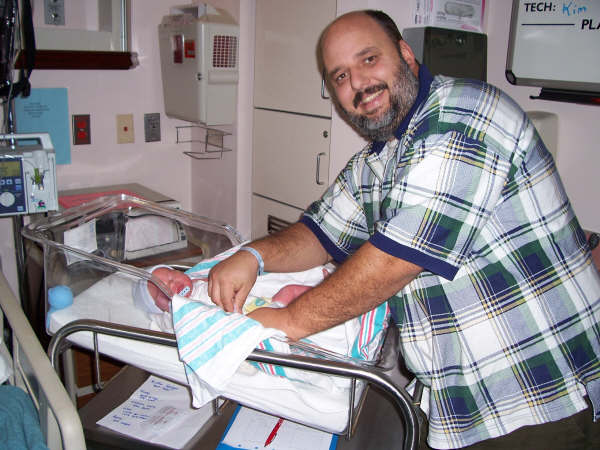
Yes, little seven-pound nineteen-inch cute as a button Stephen Michael was born yesterday morning. My brother's sister (Those of you who are paying attention will notice that this person is me. In fact, it is my brother's wife who gave birth on Tuesday. For some reason, I kept saying it wrong to everyone I told.) gave birth at 8:09 am in Pensacola, Florida. According to all sources present, he has 20 toes and fingers (inclusively) and is:
1) very cute*
2) very small
and 3) reminiscent of his father (except he has more hair!)
*See pictures above for proof of his cuteness.

Now is the time I feel it--that is, exactly how far away I am. I sit here in the university library behind a pile of books in a language not exactly my own and wonder if Little Stephen would find the book "Reexamining Democracy: Essays in Honor of Seymour Martin Lipset" interesting at all. I wonder if I'll get to spend time with him and if he'll know who I am. Will he study political science like me? Or will he choose a more "profitable" educational field like zoo-keeping or astronaut-ing? I wonder if his first word will be "Mama." Perhaps it will be "Democrat."

So many questions and so much time for him to explore the world. It's inspiring, I think--Little Stephen's new venture into the oxygen-breathing sector of the universe.


(And now a bit of irony)
On another note, in our weekly telephone conversation, my mother reminded me that every time one of her co-workers finds out where I live, he/she gasps and says, "Are you scared? Isn't she scared?" The answer is usually "No." But as I walked through one of Jerusalem's nicer neighborhoods last night on my way to meet friends for a drink, I encountered a chilling reminder of how much hate exists in the world. The graffiti I saw scrawled on the stone wall surrounding a beautiful house reminded me of the graffiti so common on random walls in Jerusalem--"wise" pronouncements of "Death to Arabs", "Death to Gays (or insert "Animals", which is a fond nickname of some sectors of society for non-heterosexuals), "Death to Rabbits" (a play on words and the slogan "Death to Arabs" in Hebrew)--graffiti that more often than not stays up longer than the current parliament coalition. Except this time, I was the target. No, it didn't say, "Death to Kind, American-ish, Liberal-ish, Idealist, Humorous, Likes Spaghetti Girls in their 20s". What was written was far more explicit (and you ask yourself, "Gee, how can it be more explicit than that?")--"Death to Vegetarians."

So, as I walked home last night, I looked over my shoulder . . .
Not for rabbit/gay person/Arab hunters, but for the guy who could see my low-iron content and knew . . .

Wednesday, November 08, 2006

Hate, abuse, and suffering--Served up hot and fresh

"For if you think that by killing men you can avoid the accuser censuring your lives, you are mistaken; that is not the way of escape which is either possible or honorable; the easiest and noblest way is not crushing others, but to be improving yourselves" --Plato, "Apology" (Socrates' Defense)

This week has been a bloody, fiery week. It's been a week of buses being re-routed, parades being re-routed, and lives of human beings--yes, human beings--being re-routed. So you won't have to guess what the above statements hint at, I'll tell you.

Yesterday, my bus was re-routed, from its usual course through one of Jerusalem's ultra-Orthodox neighborhoods, on the way home from the university due to the violent and non-violent protests of ultra-Orthodox Jews (in their own neighborhoods, thankfully) against the gay pride parade set to take place this Friday. Last year's parade was marred by the stabbings of three marchers. This year, it is not uncommon to see posters in certain neighborhoods advertising a reward of 20,000 shekels for anyone who kills a marcher. I wonder, "Is it possible that I live in a city like this?" I wonder, "Did the people in Selma, Alabama have this thought, too?"

The parade--or the "parade," since as I write this, the Israeli Supreme Court is in session to determine whether a "safe" parade can indeed take place in our city--was given a new route yesterday. The original route by-passed the aforementioned neighborhoods. The second route by-passes them even more.

Oh, but don't worry. The number of people within Israel who hate each other has not yet exceeded the number who hate each other across the formal and informal borders of the country. The numbers of those killed in Gaza by a misfired Israeli artillery shell this morning continue to go up as well (http://www.haaretz.com/hasen/spages/785380.html). As do the number of Palestinian women who are sexually, physically, and emotionally abused according to a recent report by the Human Rights Watch (http://jurist.law.pitt.edu/paperchase/2006/11/palestinian-authority-ignores-violence.php).

I think about the US mid-term elections, whose results have just about come in by now. I think about the issues on the ballot and in the news. And I think to myself, "If only we could think about 'stem-cell research' here. If only the minimum wage was the biggest thing on our minds here." But I realize that America's continued presence in Iraq (and Afghanistan, has everyone forgotten Afghanistan) is life-and-death just like the things facing us here. But it's on the other side of the world compared to America--oh, right, it's in our neighborhood--it seems less real.


I was always told--and sometimes I still believe it--that the world is not any more violent now than it was throughout world history. "We just have news now--up-to-date, live feed, instantaneous broadcast news--that brings hunger, poverty, massacres, and terrorism to our doorsteps faster than the pizza delivery man can bring us a sardine-and-onion thin-crust pie." But proximity to the violence makes me think otherwise.

So, what do we do? No, no really, what do we do--to improve the chance (if not the reality) of peace, to guarantee (if not living to an old age) at the least the chance to graduate from high school, to value life in such a way that forces us to change our trajectory course that we claim was set so long ago but that in reality we choose anew every day?

Thursday, November 02, 2006

Do I believe in peace?

I recently received an email from an acquaintance who told me: "I've been talking with a lot of people who are ready for eternal peace." It was nice to hear it, because around here, it's a bit harder to find those people.

The first person who comes to mind is the man who murdered Israeli Prime Minister Yitzhak Rabin eleven years ago today. He wasn't thinking about peace, eternal or not.

I think next of Hamas, who has upped its ransom demands to 1,200 Palestinian prisoners in Israeli hands in exchange for the Israeli soldier they kidnapped over 3 months ago.

I think now of the Moroccan man who is $12,000 richer after winning a Holocaust cartoon contest sponsored by the government of Iran.

These people they don't believe in peace. They don't even hope for it.

Now I think of myself. I hope for a perfect, eternal peace, but do I believe in it or at least the possibility of it?

No. I don't.

I am an optimist. I believe in the goodness of humanity. I am in personal ways working towards the goal of coexistence. I think we can arrive to a situation better than the one we are in right now. But I don't believe in a complete peace.

Why? Because of the people above.

Why? Because I've been here a little too long to continue closing my eyes to the reality in front of my face.

Why? Because for every prayer of peace that rises towards the sky, a bullet flies into an innocent human being.

So, why am I here-that is, if I think the situation is hopeless? The answer to that question lies in the meaning of today--the 11th anniversary of the assassination of Yitzhak Rabin.

This story does not start eleven years ago, but rather three. I was in Arad, Israel and was taking part in a group discussion, "Where were you when you heard about Rabin's assassination?" Like asking an American where he was when he heard of Kennedy's assassination, everyone had a story--everyone but me. I couldn't remember. I was thirteen years old, and yet, I didn't know. I imagine to myself now that I first heard of it in Sunday school, as it happened Saturday night Israel time, and that would have been the first opportunity for me to hear of it. But I don't know, because at that point, Israel--a place that is so important to me today--was not even on my radar screen. That night, though, three years ago, something inside of me clicked, and I knew--knew--that this would be the last time that something happened in Israel of such great import that I didn't know about. That was the day that I decided to make aliyah, to make Israel my home.

Knowing myself, knowing my dedication to positive interactions of human beings in the world, knowing the steps Rabin took to achieve peace in Israel--it seems fateful that this should be the day my decision was made.

And so, I sat this morning on my balcony, looking out into the cloudy morning, wondering where we are headed? I looked down to the nursery school playground next to my apartment building and listened to the children shrieking and laughing and . . . living. They had no idea what day it was, and thought to myself, "Wouldn't it be great if they never had to learn of the hate that causes something like this day? Wouldn't it be wonderful if by the time they grow up this chapter of violent history is over?" Yes, it would. But something tells me it won't be.

And it's not ok. But . . . there is still beauty in the world. There is still happiness and love. There is still, well, a little spark of hope that makes me think, "It won't be perfect, but it will get better . . . someday."